Happy Wednesday.
Yesterday we walked past an AI-generated billboard, an AI-generated poster for a local event, and an AI-generated menu at a restaurant. All before lunch.
Funny enough, this intro isn’t AI-generated.
Who would’ve guessed? Encountering human-written stuff online, and AI-generated stuff while you’re unplugged. A reverse Matrix.
ChatGPT Ads levels up, X launches Ads MCP server, and the IAB tries to figure out who gets paid
Sam Altman would like a word with your very real budget.
Starting with the bidding: ChatGPT Ads added automated bidding, platform targeting for iOS, Android, and Web, plus one-day view-through conversions.
It also expanded into Brazil and Mexico.
Heads up, though: View-through conversions will pad your numbers. Separate them from click-through performance before you declare victory.
And they’re hiring accordingly: OpenAI is recruiting a Head of Ads Enterprise Marketing on a $374K to $415K base to sell ChatGPT as a premium ad platform.
The product agrees. Custom audiences need 25,000 matched users minimum, 100,000 recommended.
That might be a floor too steep for small advertisers, but not for big retailers and banks.
Over at X, you bring your own robot: The company launched an Ads MCP server, letting you pipe campaign data into Claude, ChatGPT, Grok or a custom agent.
Meta, TikTok, Pinterest and Snapchat already offer this. Platform-native AI tools are now optional, not mandatory.
Meanwhile, nobody knows what any of it is worth: The IAB is drafting an AI attribution framework, due November 12.
The problem it’s chasing: when an agent reads your page, weighs competitors and buys, who gets credit? UTMs and referral data don’t survive that journey.
The agent buys, the money moves, and the receipt names nobody. November is when the IAB tries to fix that. We’ll be there.
Ad-supported streaming climbs while Instagram and YouTube chase the couch viewership
Platforms are fighting over the biggest screen in your house… Yep, the one you use when you take a break from your phone.
The numbers picked a side: Nielsen’s Q2 2026 Gauge has ad-supported streaming up 1.6% to 48.2% of total viewing.
Broadcast dropped from 28.2% to 26.6%, even while carrying the NBA Finals and the opening stages of the World Cup.
Both tournaments also streamed, so linear may have cannibalised itself.
One caveat: Total ad-supported TV finished at 71.5%, down 1.3% from Q1.
Instagram wants a seat on the sofa: The platform enlisted four creators to demo its TV app as shared, big-screen viewing.
Translation? Your vertical creative may soon need a horizontal cut built for more than one pair of eyes.
And IG is not alone in this chase.
YouTube is building actual channels: It just expanded its Stations experiment to more creators, podcasters and musicians.
Stations run 24/7 with live chat attached, so you get lean-back inventory and an audience that stays put.
Stations are available globally except in Portugal, Switzerland and Turkiye, though only a handful of new creators are getting in for now.
So far it’s looking like the big screen is getting reclaimed by the same mobile apps that pulled attention away from it.
Your client just asked if they show up in ChatGPT. Now what?
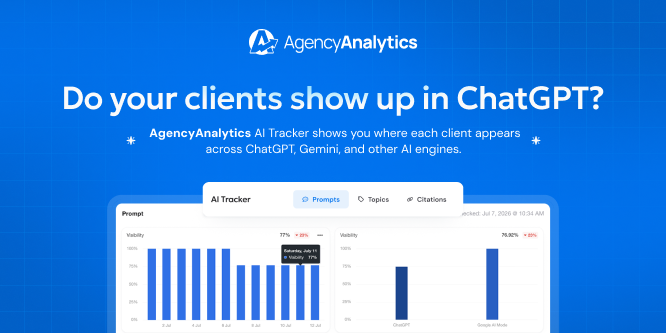
AI search visibility is the top new service clients are requesting in 2026, ahead of paid ads and short-form video. That’s from 66% of the 494 agency professionals AgencyAnalytics surveyed.
Most agencies can’t answer the question yet. 48% say they can’t track how clients get discovered through AI tools, so traffic is the only number they can show.
AgencyAnalytics‘ AI Tracker answers that question. It shows where each client appears across ChatGPT, Gemini, and other AI engines, then connects that visibility to traffic and ROI.
All of it runs inside the reporting and insights platform 7,000+ agencies already use across 150,000 clients.
Discover how AgencyAnalytics is helping agencies stay ahead.
ChatGPT names six brands but only cites four sources
Osama Saeed ran 6,120 prompts through ChatGPT across 48 industry categories.
The verdict: getting your brand mentioned there is harder than on any other engine.
The citation pool is tiny. ChatGPT averages 3.6 citations per answer, the lowest of the four engines tested. Perplexity, the next stingiest, manages 7.7.
Yet ChatGPT still names 6.3 brands per answer.
It recommends more brands than it cites sources. That gap means plenty of mentions come from model memory, not live retrieval. You can’t optimize your way onto that list in a quarter.
Nearly 5% of answers cite nothing at all. Every other engine cites at least one source in 99.3% of responses. ChatGPT only in 94.5%.
The Crew’s thought: It’s the one engine still naming brands from training data alone. Consistent long-term presence beats a burst of activity.
But how do you get cited? Mainstream press punches above its weight. Major media accounts for 6.6% of ChatGPT’s citations, roughly double that of Claude (3.3%) and Gemini (3.1%), and over four times that of Perplexity (1.4%). In Beauty and Hair Care, it hits 36.1%.
And here’s a surprise. Social and forum citations? 0.3% each. Effectively nonexistent.
The Crew’s take: Grain of salt on the importance of earned media vs community and social since we also know Reddit was a common source. Although, not anymore, as we reported.
The best bet is to research this for your own industry where possible.
Performance beats popularity, with 80.88% of ChatGPT’s brand recommendations driven by how well a product actually performs. Reputation accounts for 12.1%, price 3.1%, popularity 0.5%.
The lesson? Awareness-led messaging is not the way to go. Benchmarks, comparative data, and measurable outcomes get you cited.
Last but not least, front-load the good stuff. The bottom half of a page earns just 20% of citations. Put your numbers, proof, and specifics up top where crawlers actually look.
With more and more of your potential customers using ChatGPT, AI visibility is becoming more important, and with it, so is the right kind of earned media.
How to prime your customers’ minds to see your product as the obvious choice

You don’t need pressure tactics to convert customers.
Most people rely on mental shortcuts to make decisions. Like defaulting to the “most popular” option without even reading the fine print.
When you understand how people make decisions, you can position your products and offers more naturally.
… And make your messaging more relevant, sticky, and persuasive.
Psychology of Marketing shows you how to do this with one powerful insight each week, plus real-world ways to apply it.
In-house or agency, everyone agrees brand building comes first
In-house teams and agencies were rarely seeing eye-to-eye on everything, but now it seems like both sides are reading from the exact same strategy book.
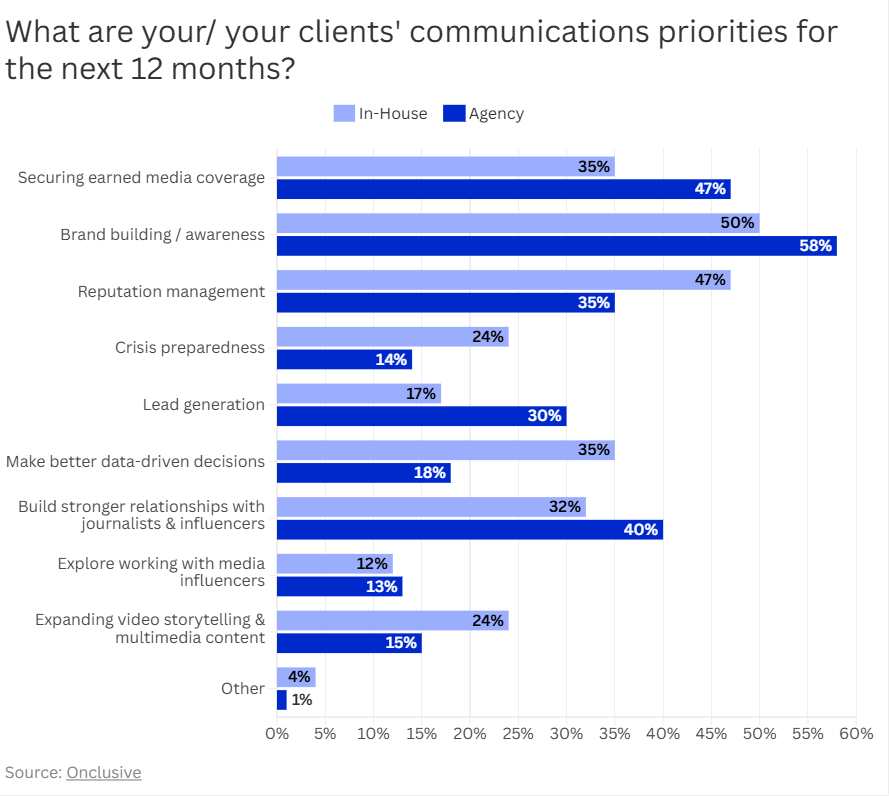
Brand awareness takes top priority.
- Brand building / awareness leads all communications goals for both Agencies (58%) and In-House teams (50%).
- Agencies focus heavily on external amplification like Securing earned media (47% vs. 35%) and Lead generation (30% vs. 17%)
- In-House teams prioritize internal stability like Reputation management (47% vs. 35%) and Data-driven decisions (35% vs. 18%).
With ad costs rising, performance channels can’t sustain growth alone.
Both agencies and internal teams realize that strong brand equity creates the baseline demand needed to make every downstream campaign cheaper and more effective.
Align your agency contracts around long-term brand equity metrics like earned reach and share of voice, rather than locking them strictly into short-term lead conversion targets.
AI MARKETING: This daily newsletter condenses the latest and greatest AI developments into a 5-minute read. They read the noise, pull out the signal, and explain what actually matters for work, strategy, and the tools your team is already using. Trusted by 700k+ readers. Subscribe right here.*
GOOGLE: Local Services Ads just jumped from 20 to over 500 Reserve with Google booking partners. And any Business Profile with an active booking link gets it switched on automatically, no linking work required. Note: those bookings land as billable paid leads. They’re not free wins.
THREADS: …is testing In-stream podcast playback with transcripts, syncing with Apple Podcasts so episodes work in sound-off feeds. With 58% of Americans listening in 2026 and video now outpacing audio-only, your podcast placements just gained a scrollable, searchable surface.
GOOGLE ADS: Performance Max is picking up an alpha “Channels” setting, letting you loosen or tighten the CPA the algorithm accepts across Search, YouTube, Display, Discover, Gmail and Maps. Budget percentages stay off-limits. Before you throttle YouTube on its attributed CPA, remember it often seeds the Search conversions you’re crediting elsewhere.
GOOGLE: Every Google tag becomes a full Tag Manager container, and visual tagging lets you click through a purchase flow to define conversions without touching code. Optimization stays opt-in, which matters if your current setup is complex. Preview those proposed changes before publishing anything.
INSTAGRAM: Rough cut, handled. First Draft trims the pauses in your existing clips and stitches the best bits into a starting-point Reel in one tap. Everything’s reversible, so reorder freely. With Reels eating half of all IG time, less editing friction matters.
INSTAGRAM: First Draft trims the pauses in your existing clips and stitches the best bits into a starting-point Reel in one tap. Everything’s reversible, so you can reorder freely. With Reels eating half of all IG time, less editing friction can be a big upside.
TIKTOK: Out of Phone just got a bigger footprint. Six new partners push TikTok creator content onto screens in malls, bars, supermarkets, wellness centres and universities across the UK, France, Belgium, Spain and Italy. That real world reach might be worth pricing out.
*This is a sponsored post.
A sundial has the fewest moving parts of any timepiece. Which has the most?
You can find the answer here.
Interested in advertising in one of our newsletters?
Connect with over 100,000 of the world’s best marketers who read a newsletter by Stacked Marketer.