Good morning.
Ever thought about how cool async remote teams are?
Somewhere out there, one team member is having a second coffee. Someone else is on a first. Two more are fast asleep. The work never stops, but nobody has to be awake for all of it.
Kind of beautiful. Just check the timezone before you send that message.
ChatGPT ads reach Europe, but the audience is getting jumpy
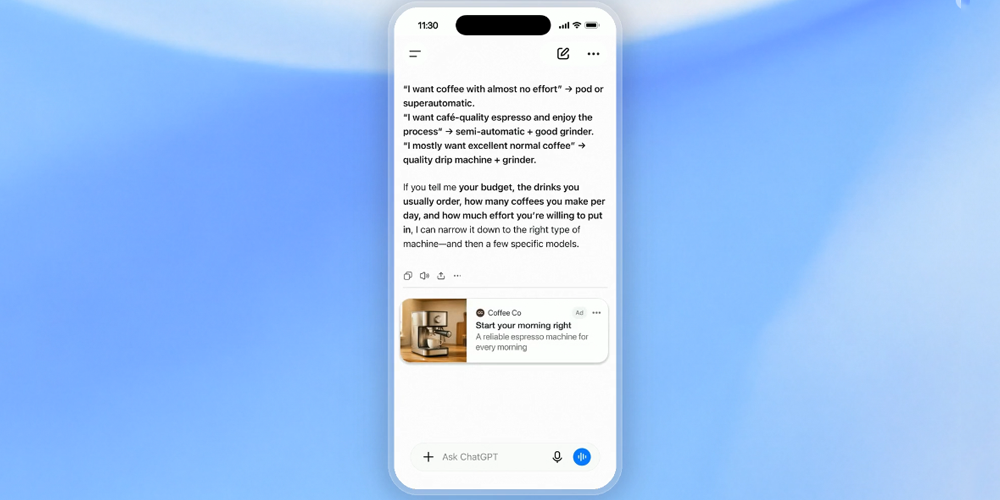
Nothing says confidence like launching an ad product in the world’s strictest privacy regime.
ChatGPT’s continental drift: OpenAI has told EEA and Swiss users that ads arrive on Free and Go “later this month”.
Targeting starts contextual only, using conversation topic, approximate location, device, time of day, language. Personalisation comes later, and only if users opt in.
Politics is off the table entirely, as are health and mental health adjacencies. Even with these caveats, it won’t be easy for ChatGPT ads to avoid controversy in the EU, that’s for sure.
But ads appear to be misbehaving, still: Brodie Clark spotted ChatGPT ads swapping advertisers mid-load, one brand flashing up before another replaces it.
On an impression-based model, somebody is paying for a blink. Probably a bug that gets fixed sooner rather than later, but still a sign of growing pains.
Worth the mess? iPullRank’s study of 13.1B search events found ChatGPT pulls a higher share of paid clicks from Google than any other top destination.
Meanwhile, Google’s zero-click rate rose 2.6 points, and organic clicks fell 2.8. Paid clicks held flat.
And the ads are spreading: Similarweb says 26% of ChatGPT replies now carry a sponsored ad, with nearly 30% of ad-eligible AI Mode queries showing ads too.
One catch: Pew has 52% of Americans more concerned than excited about AI, including 55% of under-30s for the first time. 71% expect fewer jobs in 20 years.
The channel seems to be scaling faster than the goodwill it depends on.
Google trims Branded Searches, and generative AI comes for your video assets
Nobody reads the patch notes. Which is precisely where the interesting stuff gets buried.
Spot the difference: Google updated its Branded Searches documentation, and Performance Max is no longer on the supported campaign list. YouTube and Demand Gen still are.
The default conversion window also shrank from 30 days to seven, adjustable between one and 30.
It now sits under the Consideration goal and reports into Results and All Conversions. It can’t be used for bidding, and brand mapping still needs configuring.
Your creative, but stretched: Google will use generative AI to fill in missing aspect ratios on existing PMax video ads, widening the inventory they can run across.
If you’d rather approve those edits yourself, the opt-out form closes September 4th.
Server-side, second helping: Microsoft published docs for its beta Conversions API, a direct pipe from your systems into the platform.
It’s built to run alongside UET, not replace it. Expect broader offline and cross-channel coverage, plus a ticket for your dev team.
Meanwhile, in the land grab: Microsoft is testing full-block images in mobile Bing ads, while Google trials supersized review stars in mobile sponsored results.
Both formats eat real screen space, so keep your feeds and ratings populated.
97% of agencies say accurate reporting is key to keeping clients
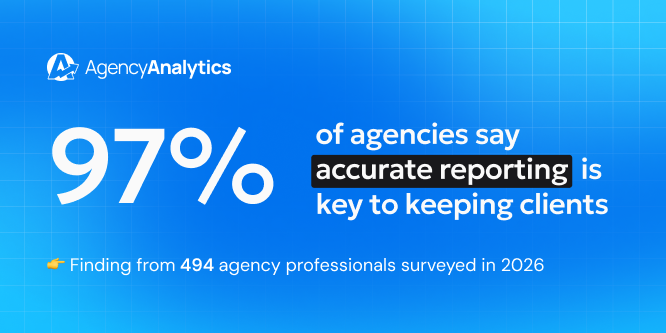
AgencyAnalytics surveyed 494 agency professionals, and nearly all said accurate reporting is key to client retention.
It makes sense. The data is the foundation for every decision you make for your clients.
AI makes building reports easy. Doing it for multiple clients, every month, with each client’s data cleanly separated, is the hard part.
That’s why 7,000+ agencies trust AgencyAnalytics for accurate reporting and insights:
- Every client’s data scoped to their account, across 85+ integrations
- AI search visibility tracked across ChatGPT, Gemini, and other AI engines
- Client tables built from a plain-language description of what you want to see
- Live client data inside the AI tools your team already works in
Your AI can answer your comments. Just tell people it’s a bot

Science Says dug into new research on what happens when creators hand their comment section to an AI agent.
Short version: it works, as long as you don’t hide it.
The numbers make a decent case: Researchers tracked 22,645 follower comments across 448 posts.
Followers who got a reply from a clearly labeled AI bot commented 41% more often on later posts and reposted content 43% more often than followers who got nothing back.
1) Being seen beats being personally answered: Reply signals attention. People knew the response came from a bot acting on the creator’s behalf and engaged more anyway.
The Crew’s take: Most brands treat comments as overhead, but they’re a retention channel.
2) Speed and relevance do the heavy lifting: The lift was strongest when replies landed within 45 minutes, addressed the actual comment, and matched the creator’s tone of voice.
Generic “Thanks for sharing!” is not what moved these numbers.
3) Diminishing returns are an issue: Accounts that already reply often saw a weaker effect.
No surprise there. Same for accounts with paywalled content, where followers may read automation as a cost-cutting move.
What we think: This is a fix for the gap between what you can answer and what you’d like to answer. If you’re already at 100%, keep your hands on the keyboard.
The caveats worth knowing: The study observed Weibo, where attitudes toward AI may run warmer than elsewhere.
Human replies weren’t tested head-to-head, so we can’t say bots beat people, only that bots beat silence.
Platform rules also vary: LinkedIn bans this outright, while Instagram allows integrations like Manychat.
Train it on your own voice, label it plainly, keep it fast, and let it absorb the volume you’d otherwise ignore.
4.9x ROI from gifting products to creators, and 93% of it from new customers

Gifting products to creators usually feels like tossing money into the void and hoping for a montage.
Omnilux ran the numbers instead: Using Superfiliate, their gifting programs returned 4.9x ROI, and 93% of tracked revenue came from brand-new customers.
The unlock? Every gifted device automatically generates an affiliate link, so 100–200 monthly gifts turn into trackable clicks, sales, and attribution.
No manual orders. No guessing which creators are worth paying.
Brand building keeps stealing the budget spotlight
Allocating resources is always a balancing act.
But marketers seem to be slowly shifting their weight.

Demand holds the lead. Product & Demand commands the top spot at 35% (Oct 2025), though it dropped slightly from 38% in Aug 2024.
…but brand gains momentum: Resource allocation for Brand steadily climbed from 23% in Aug 2024 to 27% in Oct 2025, proving long-term identity is reclaiming budget share.
Flatliners: Business Transformation (23%) and Customer Experience (15%) remained virtually unchanged across the board.
The takeaway: Marketers are learning that capturing demand without building brand equity creates an expensive dead end.
This gradual shift reflects a realistic return to balancing short-term sales capture with long-term mental availability.
What you can do: Reallocate 5% of your performance ad budget into distinct, top-of-funnel brand campaigns before acquisition costs spike further.
AI MARKETING: This daily newsletter condenses the latest and greatest AI developments into a 5-minute read. They read the noise, pull out the signal, and explain what actually matters for work, strategy, and the tools your team is already using. Trusted by 700k+ readers. Subscribe right here.*
META: A federal trial opened in Oakland, where 29 US state attorneys general argue Facebook and Instagram were engineered to hook teens. Damage talk runs from $200 billion to $1.4 trillion, which is exactly between Meta’s 2025 revenue and its current market cap. Both are unrealistic, but consequences on algorithms and user experience are a different story.
GOOGLE: The August 2026 spam update is rolling out now, globally and across every language, with a few days to finish. It’s the third of the year after June’s. Watch your rankings this week because clean sites do regularly get caught in the blast radius.
YOUTUBE: Starting August 24, a view counts globally from the very first frame across all formats, matching the Shorts standard. Expect view counts to inflate overnight. The old metric survives as “Engaged views” in Advanced Mode, so that’s the number worth benchmarking your partnerships against.
GOOGLE: That experiment putting AI-generated step-by-step images into recipe AI Overviews is dead after publishers pushed back hard. Google clarified this wasn’t the Nano Banana feature announced in July, which still lets searchers generate images inside AI Overviews, but only when they explicitly ask for one.
*This is a sponsored post.
Samuel was out for a walk when it started to rain. He did not have an umbrella and he wasn’t wearing a hat. His clothes were soaked, yet not a single hair on his head got wet. How could this happen?
You can find the answer here.
Interested in advertising in one of our newsletters?
Connect with over 100,000 of the world’s best marketers who read a newsletter by Stacked Marketer.