Good morning,
Friday coffee hits different.
We’re not sure if it’s the caffeine or the fact that the weekend is close enough to smell. Science would probably disagree. Science doesn’t run a newsletter, though.
Either way, pour another cup. You’ve earned it, and today’s issue pairs nicely with it.
AI Mode is becoming a storefront, a forum, and an ad unit
Search was once full of links, but now you can almost forget it…
Google spent these days renovating the room while you were out buying holiday inventory.
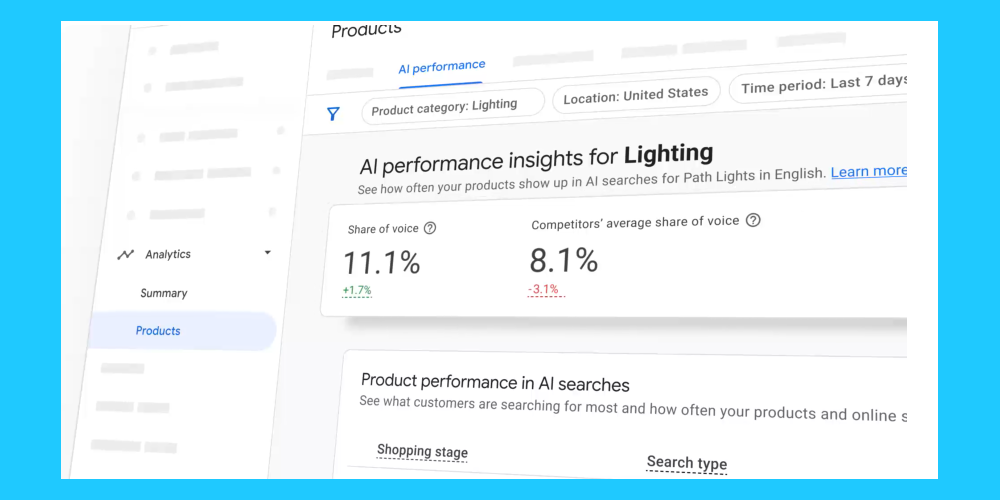
Shopping got agentic, officially. Merchant Center’s AI performance insights are now generally available in the US, Canada, Australia, India, and New Zealand.
That means share-of-voice data on how your brand surfaces in AI Mode and AI Overviews. Guessing season is over.
The ads have moved in too. Sponsored listings now sit beside organic products inside AI Mode on mobile, after appearing on desktop first.
And there’s a shortcut past the blue links. Google is placing an AI Mode button inside the search bar above results, one tap from a conversational answer instead of a SERP.
Forum energy, now in the answer. A “What people are saying” section pulls community discussion into AI Mode, on mobile and desktop.
So your Reddit and forum presence is becoming an AI Mode visibility lever on top of a classic search one.
One more number worth feeding into your product data: lululemon’s conversational attributes showed up in 50% of relevant AI Mode recommendations during testing.
There’s a visible pattern across all Google’s movements: it’s turning the answer itself into the destination, the ad unit, and the review section. All at once.
But Google is not the only one going heavy on AI. Let’s see what Meta has been up to.
Meta drops new features and they come with a price tag
Meta spent this week doing its best streaming-service impression: bundle everything, give it a short name, then slice it into six tiers.
The headliner is Meta One, now live globally, from $2.99 to $499 a month. 15 million subscriptions and trials already.
Buried in the business tiers is the one you actually want: links in organic Instagram posts.
Four a month at $49.99. Twelve at $499. You also get competitor benchmarking on 10 brands and insights past the 90-day wall.
Creator deals got smoother too. The Creator Marketing Hub went global, pulling Facebook creators into the Marketplace API.
You can now run Partnership Ads straight from your own AI agent. Instagram Live video ads are generally available on September 29.
And the grunt work is gone. A new WhatsApp Business MCP server lets Claude, Cursor, or ChatGPT create the account, verify the number, and build your templates.
Days of setup, now just a chat.
You already knew organic reach was never free on Meta properties. At least now the receipt is itemized.
Launch 50 ads in three minutes, not three hours
Uploading ads one by one in Ads Manager is the marketing equivalent of Groundhog Day, minus the character development.
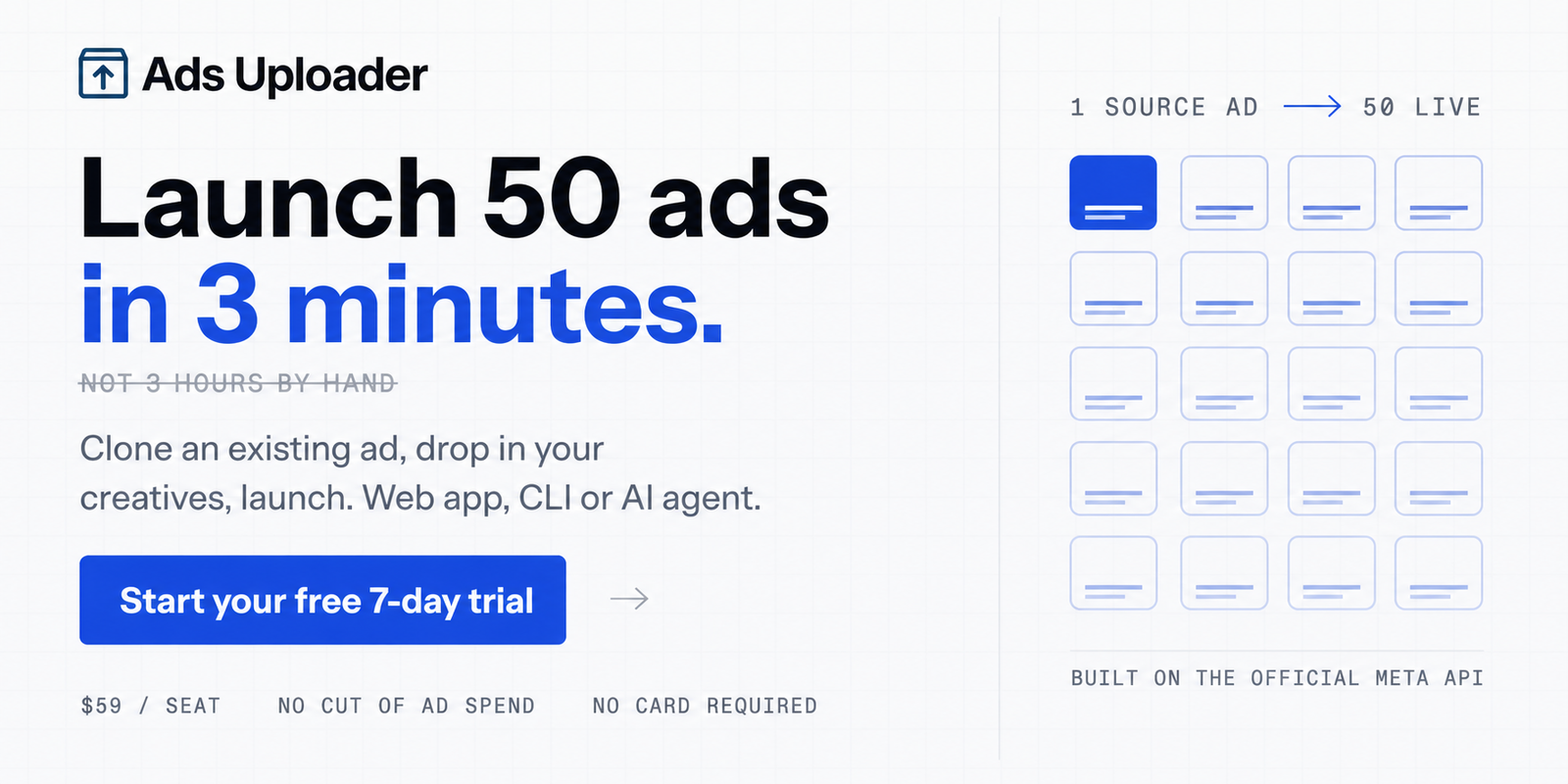
Clone, don’t rebuild. Ads Uploader mirrors an existing ad’s entire campaign structure — audiences, ad sets, settings. Add creatives, launch.
The math: A 50-variation batch takes 2–3 minutes instead of 2–3 hours. Agencies recover $2,000+ in billable time monthly.
No spend tax, ever. $59 per seat ($44/month annually). No cut of ad spend, no account caps, no AI credits.
Your call, or your agent’s. Web app, CLI, or MCP with Claude and ChatGPT. Same pipeline, the official Meta API.
Battle-tested: Media buyers and agencies in 60+ countries launch tens of thousands of ads through Ads Uploader every single day.
Nothing to lose but the busywork. Try it free for 7 days. No credit card, no commitment. See exactly how much time and money you save.
Your most expensive option should not wear the badge
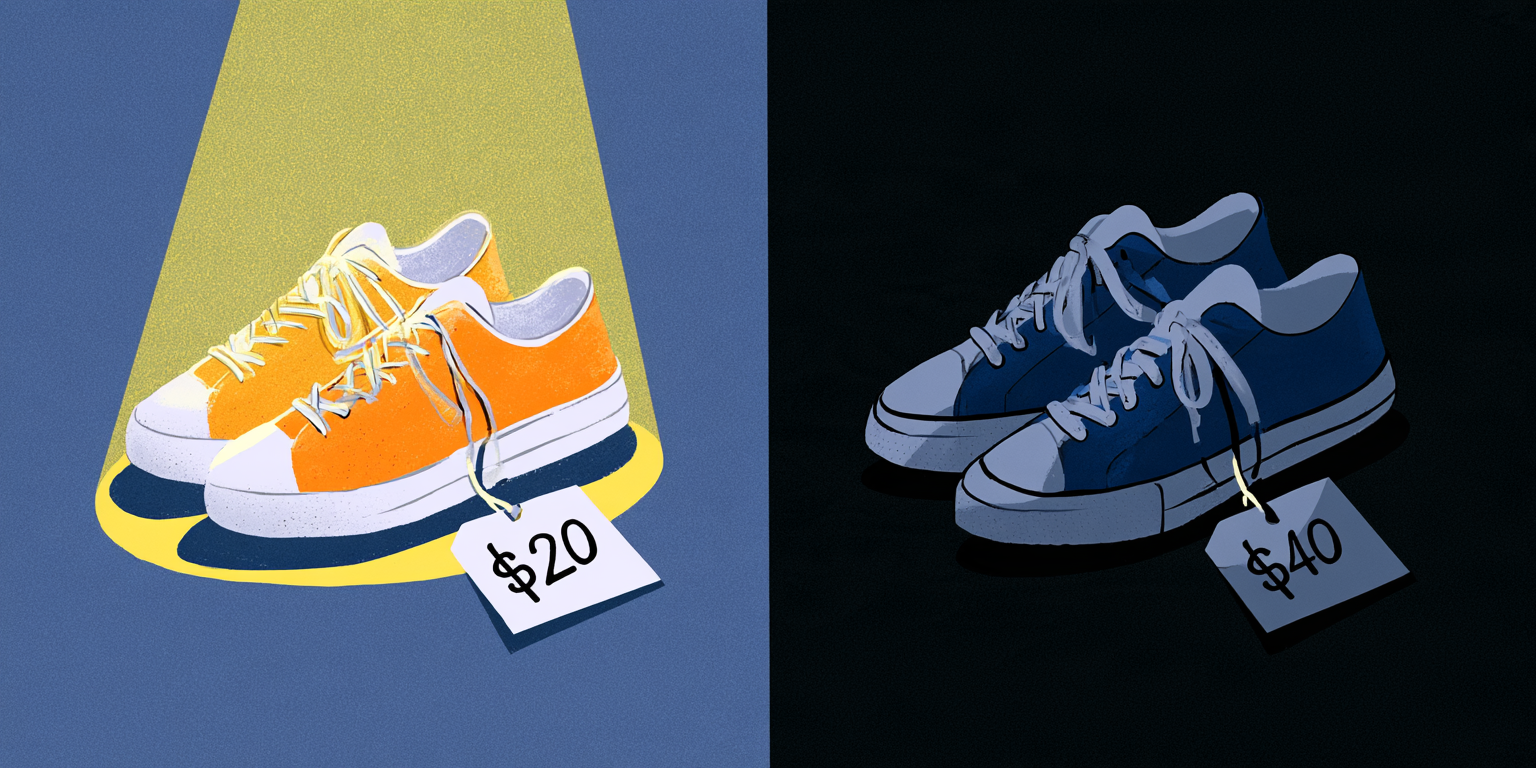
Move your “recommended” label down the price list.
At least that’s what Science Says writes. They found a research of eight experiments, 6,200 participants, and one mildly uncomfortable truth about how shoppers read our badges.
The Amazon’s Choice numbers are the ones to steal. An “Amazon’s Choice” label on the second-most-expensive product lifted selection by 159%.
The same label and product priced third-cheapest against competitors: 357%.
What we think: The badge is not doing the work alone. The believable price is a strong partner, and the two together are a match made in sales-heaven.
It’s not just for products you can sell on Amazon. A cafe in South Korea ran the test on drinks, and sales of a recommended drink climbed 58% when a pricier option sat beside it.
Without the recommendation, the two sold evenly.
Broader testing matched it: 24% more purchase interest when the recommended item was the cheapest, 8% less when it was the priciest.
But remember, everyone knows a recommendation is a nudge. When it points at the top of the price list, people read margin grab and quietly discount the advice.
Point it lower, and the ulterior motive evaporates.
Credibility is the asset here, and price position is what buys it.
You might think this is the decoy effect. It isn’t. Adding a more expensive option only helped when the cheaper product carried the recommendation.
When is the premium option genuinely the right answer? Give an objective reason that isn’t us: “Our bestseller,” “Judge’s Choice.” Borrowed authority beats self-interest.
This held for comparable items with visible prices, so it may not survive when products differ obviously.
And it weakens in categories where people lean hard on recommendations anyway, like hotels and cars.
Test it small before rolling it out everywhere.
So. Much. AI news. How do you know what’s worth your attention?
There’s always something new with AI, but not everything deserves your attention.
Good thing The Deep View only focuses on AI developments that could actually impact your work and decisions.
It shares must-know updates into a fun, 5-minute read and has helped 500,000+ professionals stay informed without drowning in the constant flood of updates.
Even readers from Google, Meta, Microsoft, and a16z start their day with these insights.
Consumers are using AI to shop… but mostly to trim the fat
Consumers aren’t asking AI to build their entire shopping list from scratch—they’re hiring it as a product referee to blow the whistle on mediocre choices.
Semrush data shows AI tools thrive right in the middle of the sales funnel:
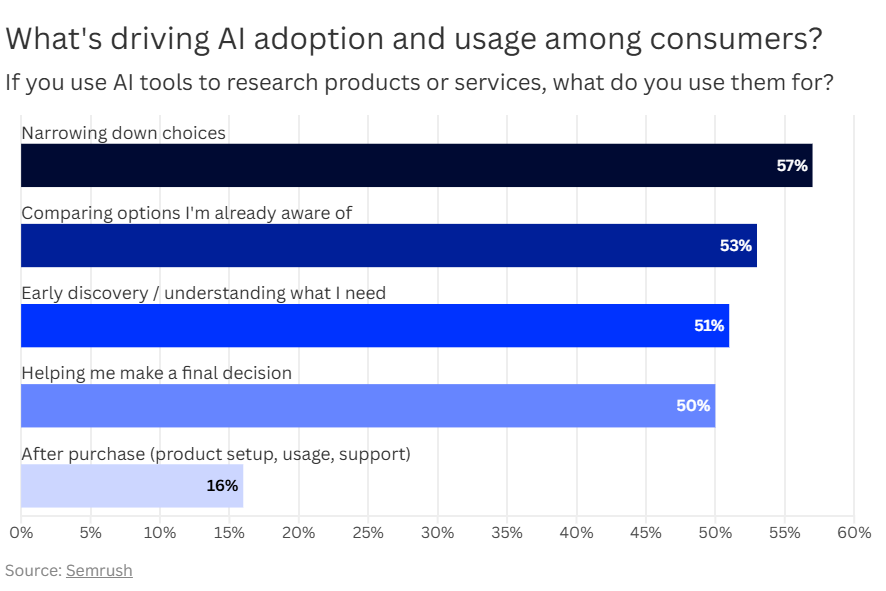
- Mid-funnel filter: The top driver is narrowing down choices (57%), followed closely by comparing existing options (53%) and early discovery (51%).
- Closing the deal: A solid 50% rely on AI to help make that final purchase call.
- Post-purchase ghosting: Only 16% turn to AI tools for post-purchase setup or support.
Shoppers suffer from massive decision fatigue.
AI acts as their ultimate shortcut, digesting specs and reviews in seconds.
If your brand isn’t visible in LLM search answers during that critical comparison window, you’re getting filtered out before checkout.
Structure your site with clear product comparisons, FAQs, and explicit specs so AI models easily digest and recommend your brand during evaluation queries. Yep, the usual.
SOCIAL MEDIA: Most social tools track what you post. Planable Social Listening tracks what people say about your brand, your industry, and your competitors across 8 sources including Reddit, blogs, and the open web. AI sentiment included. From $99/month, 30-day free trial on any paid plan.*
PINTEREST: Visual Search Ads just landed at Pinterest Presents, planting your bids inside search results and Pin closeups, then sending clicks straight to your site. With 80 billion monthly searches and over half commercial, beta opens in every ad market within weeks. Just in time for the shopping season.
REDDIT: An audit of 30,000 AI search answers found formal, heavily upvoted comments got picked, while first-person language dropped from 3.3% to 0.06%. So the lived-experience goldmine you mine Reddit for is being sanded down into generic advice.
STREAMING: Top nine premium platforms packed in 18% more ad minutes since January, with Paramount+ at nine minutes an hour, while ad-tier prices rose 14%. Churn sits near 4% and viewing is up 5%, so viewers are absorbing it, for now.
GOOGLE ADS: Asset Studio now dubs your video ads into 33 languages and locales, free for select advertisers. No reshoots, no local crews, just one hero video stretched across markets. Worth testing before competitors flood every country with the same spot.
GOOGLE: Clicks on free product grid listings in web search are being sent straight to your product page instead of that multi-retailer overlay. Spotted by Brodie Clark, and still a test, but it hands you the visit and drops the comparison step.
GOOGLE ADS: Spend Benchmarks now tells you whether you’re outspending businesses Google deems similar. One advertiser saw €284 against a rival’s €268. Handy context, but matching on industry and location ignores your margins and AOV, so let profit set budgets.
*This is a sponsored post.
Interested in advertising in one of our newsletters?
Connect with over 100,000 of the world’s best marketers who read a newsletter by Stacked Marketer.