
Happy Wednesday.
Are you one of those people who sets a yearly reading challenge? Fiction, nonfiction, the works?
We don’t. Tried it once. Somehow ended up reading less. Turns out slapping a number on a hobby is a great way to turn it into homework.
Some metrics are better left unmeasured. We’re looking at you, too, “post consistently.”
Google finally shows you your AI search performance, and quietly expands AI ads

Now you’ll know why your organic traffic tanked.
…or at least that’s what you can tell your clients: Search Console now shows how your site performs inside AI Overviews, AI Mode, and Discover.
- What the report covers: impressions, pages, countries, devices, and dates.
- What it omits: click data and query-level metrics.
You’ll know if you’re showing up, you just won’t know if anyone’s acting on it. Classic Google.
There’s also an opt-out toggle being tested, letting you control whether your site appears in AI Overviews and AI Mode entirely.
If not, you won’t receive traffic or impressions from generative AI features. But it won’t affect your rankings in regular search results… according to Google. Oookay.
The feature is currently rolling out on select websites only.
Speaking of AI Mode… it’s wellness-focused: Google confirmed it’s testing ads inside AI Mode, starting with US healthcare advertisers.
The eligible campaign types are PMax, AI Max, Shopping, and Broad Match, which are the same ones that already run in AI Overviews.
Ads with locked copy or legal disclaimers won’t qualify in this first phase, so not every creative makes the cut.
Even if you’re nowhere near healthcare, watch this closely. This is the dress rehearsal for every industry.
Video reactions on X, Instagram helps you organise your Reels, and Meta’s AI got played by hackers
Instead of burning a hole in your keyboard, just speak what’s on your mind.
Reaction culture found a new toy: X’s React with Video feature lets you record overlay reactions directly inside the app.
It comes with background removal, picture-in-picture, and split-screen built in. Record, pause, preview, and publish as a reply. Done.
Commentary-style video content on one of the most reactive platforms? Let’s see how it goes.
Meta is thinking in seasons: Reels Series lets you bundle new and existing Reels into an episodic hub on your profile.
This lets audiences watch in order, save for later, and pick up where they left off. Monetisation is on the roadmap, with a paywall model similar to TikTok’s likely on the way.
Episodic content builds the kind of audience that chooses to come back. Own the habit loop before the feature becomes table stakes.
Is AI on the wrong team? Hackers took over high-profile Instagram accounts by asking Meta’s AI support bot to swap login credentials. It worked.
Meta patched it, but as AI takes on more support and access functions, this kind of exploit becomes easier to attempt and harder to catch before damage is done.
If you manage high-value accounts for clients, review your access controls now. An AI that can act on your behalf can also act against you.
Smartphones with robot arms that sing lullabies. We’re not making this up

The Hustle is business news for people who hate business news.
While everyone else is covering the same tech announcements, they’re tracking the stories that actually surprise you: resale startups turning your closet into tradeable assets, smartphones with robot arms that sing lullabies, and Finnish companies selling snow preservation kits to desperate ski resorts.
Every day, 1.5M readers get the odd, the overlooked, and the surprisingly brilliant. It’s fascinating, it’s fun, and it takes just 5 minutes.
How to know what percentage of your Meta Ads traffic is quality traffic?

Why is it that Meta Ads can look like they’re working right up until the moment you check your bank account?
Jon Loomer has a fix for one of paid media’s most frustrating traps: Ads that look healthy but convert nothing.
The usual instinct is to blame the landing page. CTR looks solid, CPC seems fine, so the traffic must be good, right? Not necessarily.
Those metrics say nothing about traffic quality.
Why this matters: Clicking an ad and actually engaging with a page are very different behaviors.
Bots, accidental clicks, and low-intent browsers all inflate your click numbers while buying exactly nothing.
Jon’s solution: A custom metric he calls Quality Traffic Percentage.
It fires a custom event via Google Tag Manager when someone spends at least 15 seconds on the landing page.
That threshold is intentionally modest. The goal is to filter out immediate bounces and bot traffic that can sabotage your optimization signals.
From there, you calculate what percentage of total landing page views hit that 15-second mark. Run it through the compare attribution settings using 1-day click and first conversions only.
Our take: The “first conversion” piece is easy to overlook but critical.
A 15-second visit isn’t the same as a purchase. People can trigger it repeatedly, which inflates the number if you’re not careful.
The metric means little in isolation. Its power comes from comparing it across campaigns, ad sets, and ads.
Jon tested this directly when running ads optimized for landing page views.
The Quality Traffic Percentage for those campaigns was 7X lower than for campaigns optimized for purchases or leads, despite Meta’s AI Business Assistant claiming otherwise.
Turns out the algorithm was sending you traffic, just not the kind that has a wallet…
Stop drowning in AI information overload

Your inbox is flooded with newsletters. Your feed is chaos. Somewhere in that noise are the insights that could transform your work—but who has time to find them?
Replace hours of scattered reading with five focused minutes. While others scramble to keep up, you’ll stay ahead of developments that matter. 500,000+ professionals at top companies have already made this switch.
How will fans watch this year’s World Cup?
Gone are the days when the entire family huddled around a single bulky living room TV set.
Today’s football fans are multi-screening, streaming, and scrolling all at once.
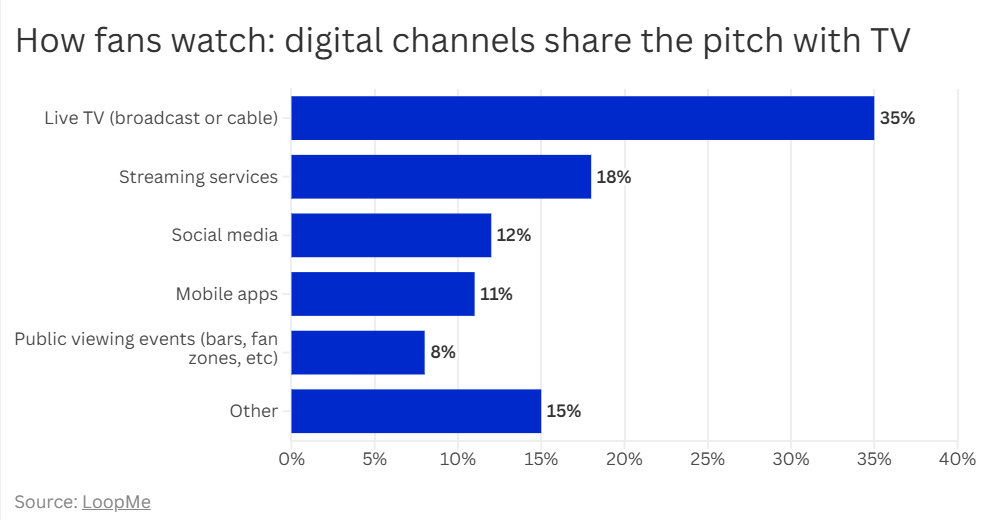
Traditional broadcast TV still holds the largest single slice at 35%, but it no longer holds a monopoly on the match-day experience.
The remaining 65% is split across a diverse digital portfolio. And those digital channels are aggressively closing what was once a huge gap.
Streaming (18%), social media (12%), and mobile apps (11%) together account for 41% of viewing. More than TV by itself. That’s not a footnote
The Crew’s Take: Linear TV ads alone won’t cut it anymore.
Audiences are inherently distracted; your campaign needs a multi-platform presence across streaming overlays and real-time social channels to capture viewers where they’re looking.
Actionable Tip: Pivot a meaningful portion of your broadcasting budget toward digital video platforms and programmatically targeted mobile ads.
Ensure your creative assets run simultaneously with live matches to capture the multi-screening audience.
Did you find this insight valuable? Pro subscribers get them frequently, including tips on multi-platform audience strategy or real-time campaign coordination tactics for capturing distracted, multi-screening viewers.
CASE STUDY: Shift skipped paid social and ran niche newsletter sponsorships instead. CPC came in at $1.72 — vs LinkedIn’s $5–$15 for the same audience. See how they did it on Paved.*
GOOGLE: AdSense can now share full IP addresses in bid requests, which many buyers use to assess impression quality. The feature is off by default, sitting quietly under Brand Safety settings, waiting for you to notice it. Turning it on is a small step that could increase what advertisers are willing to pay for your inventory.
VIDEO MARKETING: AI video can feel too unpredictable for client work, but it’s time to play director. DeepMind’s new Gemini Omni prompt guide shows you how to use plain language to steer camera angles, lighting, and styles. Swapping a butterfly for a bee? Piece of cake.
ECOMMERCE: No more locking your retail media spend to basic onsite placements. Google’s Commerce Media Suite now integrates with Demand Gen, letting you deploy retailer first party data across YouTube, Discover, and Gmail. Nice.
GOOGLE: We love getting our money back, and Google is making it easier to track. New help documentation spotlights the underutilized Invalid Activity Credit Report, giving you a transparent breakdown of refunded spend from fake clicks across Search and PMax.
GOOGLE: From July 1st, updated Ads Terms of Service allow Google to use AI to format, select, and generate targets, ads, and destinations on your behalf. You stay responsible for whatever it produces, which is a fun arrangement if you enjoy accountability without control. Read the terms carefully and decide how much of the wheel you want to hand over.
LINKEDIN: AI chatbots pull from LinkedIn more than most people realise, making your profile and content a source of answers even when nobody searches for you directly. Consultant Brooke Weller explains how structuring content for Answer Engine and GEO is now a real visibility strategy. If you want AI to recommend you, write like you want to be quoted.
*This is a sponsored post.
What falls but never breaks? What breaks but never falls?
You can find the answer here.
Interested in advertising in one of our newsletters?
Connect with over 100,000 of the world’s best marketers who read a newsletter by Stacked Marketer.