
Happy Friday.
Funny how it works. We sit at our laptops for hours, and nothing. Then we close them, brush our teeth, get in bed… and boom. Headline ideas. Campaign angles. Entire newsletters.
Our best work happens precisely when we can’t write any of it down.
Anyway, this intro came to us at 1 a.m and we managed to write it. Yay! You’re welcome.
Your customers can now shop from Amazon through Pinterest, and LinkedIn launches its own creator marketplace
The online high street just got the coolest new store.
Pin it, then cash it: Pinterest’s new Amazon Storefront linking lets eligible creators auto-apply affiliate links to their Pins. No manual IDs, no fuss.
For the uninitiated, Amazon Storefront lets creators build a curated shop of recommended products and earn commissions on sales.
Now those picks travel straight onto Pinterest, and creators get their Storefront handle featured right on their profile.
Pinterest says more than half of its 631M monthly users show up to shop and fire off over 80B searches a month. That’s a serious pool of high-intent eyeballs.
So if you or your partners run Amazon affiliate programs, this is an easy way to expand reach across both platforms.
Meanwhile, LinkedIn wants to play matchmaker: Its new Creator Marketplace lets you find and partner with vetted creators directly.
Search by topic and expertise, size up each creator’s audience, performance, and fit, then slide into the DMs.
It lives in Campaign Manager and rolls out first in the US and Canada. Creators self-enroll through a fresh Monetization tab.
LinkedIn also debuted BrandWorks, a team of brand, creative, and content experts who give B2B marketers hands-on strategy support for higher-performing campaigns.
The logic is simple. Creator-led promotions drive better response, and revenue share keeps top voices posting, which keeps engagement and your ad opportunities flowing.
Your audience now tells Instagram what they want, a new holiday guide, and features to take advantage of the World Cup
The algorithm is asking for your notes.
Instagram’s in particular: Your Algorithm controls have expanded to the main feed, so you can view, remove, and add the topics that drive recommendations across Feed, Reels, and Explore.
Before, the system learned only from what you tapped, watched, and shared. Now you can tell it straight up what you want to see.
Instagram discovery increasingly rewards matching user interests over follower counts.
Your content needs to signal clear topics and audience intent, because those are exactly the signals deciding where your recommendations land in the future.
Speaking of seeing the future: We’re halfway through 2026, which means it’s time to map your holiday push.
Meta published a 34-page holiday marketing guide built around three pillars: Using Reels for awareness, partnering with creators for reach, and removing friction from buying.
The numbers make the case. Meta says holiday shoppers on its apps spend 1.2x more than average, and 78% have bought directly in-app.
But the real gold is the quarter-by-quarter roadmap, which you’ll find here.
Are you buzzing for the World Cup? Meta is, and it’s football-ifying every app it owns.
Threads gets live chats and score alerts, Instagram launches a dedicated World Cup search hub, and Facebook adds a Football Mode and AI team-jersey selfies.
Messenger and WhatsApp bring live match updates straight into your chats.
A global event this big is a built-in moment. Don’t score an own goal.
Your ad spend has a leak. Here’s how to find it.
Meta is spending your money on audiences it built from a pixel and a prayer.
Costs are up 19% this year. The algorithm is still guessing. And you’re funding the experiment.
The fix isn’t a bigger budget or a new creative.
Find out where your budget is actually going.
The Meta ads mistakes that are ruining agency accounts

Jon Loomer has seen enough broken accounts to know the wreckage usually comes from the people meant to be helping.
Most agencies aren’t malicious. They’re just stuck using a 2016 playbook in 2026, and clients pay for it. Here’s where they go wrong.
1) Incorrect access to account assets: When an agency owns the client’s Facebook Page or ad account, the client gets stranded the moment the relationship ends.
The proper setup is simple. The client owns every asset, and the agency joins their business portfolio as a partner.
Hoarding the account doesn’t protect your strategy. It hides the fact that you don’t really have one. Your value lives in daily problem-solving, not locked-down campaign settings.
2) Heavy lean on remarketing: Remarketing already happens automatically through Meta’s algorithmic targeting.
Manually carving out those audiences usually inflates the numbers without driving a single incremental sale. High-ticket funnels and top-of-funnel optimisation are rare exceptions.
Why this matters: When remarketing dominates an account, it’s usually taking credit for conversions that would’ve landed anyway.
3) Complicated campaign construction: Spreading a $50 budget across multiple campaigns and ad sets starves every one of them.
None gets enough data on their own, so consolidate toward a single goal instead.
The bottom line: Complexity rarely improves results; it just hides what’s working. For most accounts, one campaign and one ad set is the smarter starting point.
4) Obsession with ad copy and creative control: A single modern ad now holds up to five texts, five headlines, and ten-plus images or videos.
In other words, millions of combinations. Hunting for one “winning” variant the old way is obsolete.
What we think: Forcing your budget onto a hand-picked winner just looks busy. Feed the algorithm strong inputs, learn from what performs, and let it handle the optimization.
Jon’s full breakdown, all seven mistakes, is worth your five minutes in the original post.
The AI briefing 700k+ decision-makers read every day
AI is now part of every one of those decisions, but keeping up with every model launch, company move, and workflow shift is not realistic on your own.
The Deep View gives you the AI context in five minutes a day: what changed, why it matters, and what to watch next.
It is built for people who need signal, not another feed to manage. Free, clear, and trusted by 700,000+ readers at Google, Meta, Microsoft, and beyond.
Agencies think they’re crushing it. Clients? Well…
Mirror, mirror on the wall, who is the best agency of them all?
“We are!” your agency may shout. But the clients may mutter: “Eh, not really.”
It seems we have a bit of a delusion problem on our hands:
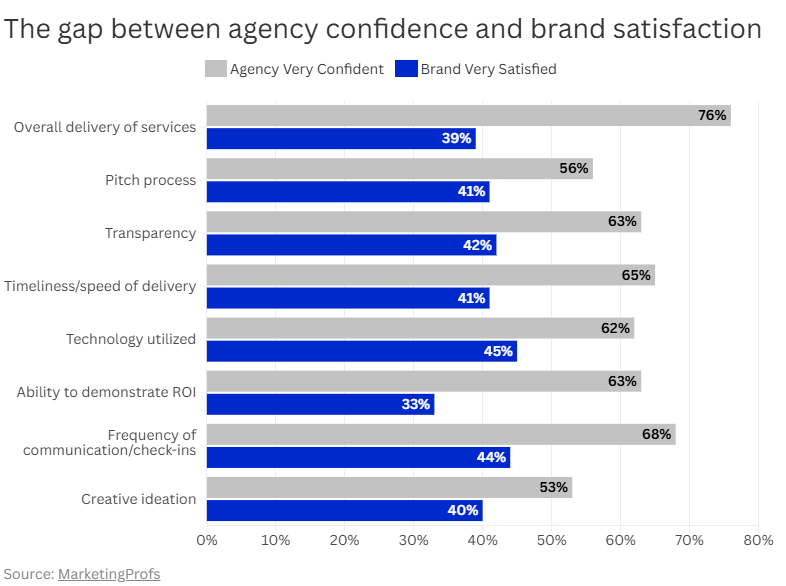
The disconnect here is actually staggering.
- 76% of agencies are very confident in their overall delivery of services.
- 39% of brands are very satisfied with their agencies’ delivery.
That’s what you call a perception gap and it doesn’t get much better elsewhere.
Agencies rate themselves significantly higher on transparency (63% vs 42%) and frequency of communication (68% vs 44%).
The only metric where the gap narrows is creative Ideation, but even there, agencies think they are doing better (53%) than clients feel they are (40%).
The uncomfortable truth: This is a bit like the Dunning-Kruger effect.
Agencies often mistake “no complaints” for satisfaction, but silence isn’t approval. Most of the time it just means the client is quietly looking for your replacement.
The Crew’s Tip: Stop assuming you’re crushing it. Send out a Net Promoter Score (NPS) survey to your clients this week.
The feedback might sting, but it’s better than a surprise cancellation notice.
SCIENCE OF ATTENTION: When everyone zigs, the smart marketer uses psychology to zag. Learn the science of differentiation to create offers that demand attention. One actionable tip per week, backed by research, zero fluff.*
YOUTUBE: Direct messaging just expanded from Ireland and Poland to the US and beyond. Send an invite, get a yes, and you can swap videos and react live. This means engagement stays in-app while the platform learns what your audience loves to pass around.
RETAIL: Dads are swarming in gifts this year, with Father’s Day spending set to hit a record $28B per the NRF. Before you feel too loved, blame inflation; Mom still pulls nearly $10B more. Electronics and personal-care items lead the gains, so stock the gadgets your shoppers want.
AEO: Claude referral traffic nearly quadrupled from January to April, a 386% jump that makes it the fastest-growing AI source SE Ranking tracks. Don’t celebrate yet, though, as it’s still at 1.4% of all AI-related traffic. So treat it as an early signal worth watching, not a budget line.
SEARCH: Only 26% of Gen Z Australians start product research on Google, versus 40% of everyone else, per Oysterly Media. A full 74% now kick off on social platforms or AI tools. Yet brands keep funneling budget into channels their customers have already ditched.
*This is a sponsored post.
If you have me, you want to share me. If you share me, you haven’t got me. What am I?
You can find the answer here.
Interested in advertising in one of our newsletters?
Connect with over 100,000 of the world’s best marketers who read a newsletter by Stacked Marketer.