
Happy Monday.
We don’t know about you, but we’re approaching that time of year where stepping outside feels like opening a preheated oven. And we are not ready. We are not.
Somewhere between “it’s a dry heat” and “at least it’s not humid,” we’ve lost the will to debate it. Hot is hot. The AC is on. The iced coffee is made. Let’s get into it.
Bots own the web, intent now beats authority, and Google trusts no one’s tools but its own

Someone is Googling more than you.
And they ain’t human: Cloudflare CEO says bots now make up the majority of web requests, pulling 57% of the world’s web traffic versus 43% for us humans.
Where a shopper pokes around five sites, an agent blitzes through thousands, piling on server load without the clicks, ad views, or customer relationships you planned for.
That’s another sign that your content needs to be machine-readable and human-readable.
Speaking of who wins with the machines: Aleyda Solis’s analysis of SISTRIX data from Google’s May core update found that authority alone no longer makes the winners.
Big names took it on the chin. nytimes.com and nih.gov both dropped, while original sources climbed and the middlemen slipped.
The thing that made a difference was source-type fit. Did the page show up with the right tool for the job? Match the query’s intent, market, and result type, and you’re in.
Her advice: For each query that matters, spot which result type gained, then make sure your page is that type and not an echo of whoever already owns the spot.
And finally, Google’s saying no: It published new guidance on third-party SEO tools, services, and advice, making it crystal clear that it endorses exactly none of them.
The bits worth pocketing:
- Third-party tools can’t see Google’s internal ranking data, so trust no one.
- Side-eye anything waving an “approved” or “Google-acceptable” badge.
- Hold AI-search tools up against Google’s own official guidance.
- For SEO audits, hand over read access to Search Console only.
Google’s source of truth is Search Console, which pulls its data straight from the horse’s mouth. Keep on top of the documentation, and you should be golden.
ChatGPT open new ad doors, Microsoft just freed crypto exchanges from Search-only limits
Two ad platforms just threw open their doors, and the paint’s still wet.
Across the pond: ChatGPT now runs ads in the UK, and the rollout is moving fast enough to catch advertisers flat-footed.
The rules are strict. Ads only serve to users who explicitly opt in and consent is the legal basis under GDPR.
Opted-in users get personalized ads pulled from past chats, memory, and ad history. Everyone else gets generic, contextual ads tied only to whatever they’re typing right now.
The rollout echoes the US, with rep-sold inventory first and self-serve to follow. The ads manager stays US-only for now, though US advertisers can still buy UK inventory through it.
UK agency partners say some campaigns go live any minute, others within seven days.
Microsoft loosens crypto’s leash: Audience Ads for cryptocurrency exchanges are now welcome in every market where Microsoft accepts crypto advertising.
Until now, exchanges were stuck in Search only. Display and native placements across MSN, Outlook, and Edge stayed off-limits.
Audience Network lets you reach prospects earlier, at scale. Think financial news pages and the inboxes of users flagged as financially active.
A few things to note before you dive in:
- Audience Network runs on CPM, and audience signals replace keyword targeting.
- Only first-party brand owners qualify. Affiliates sit this one out.
- You carry the compliance burden, so Microsoft won’t police your licensing.
Nobody loses their Search seat. Audience access just pulls up an extra chair.
HubSpot AEO is here!
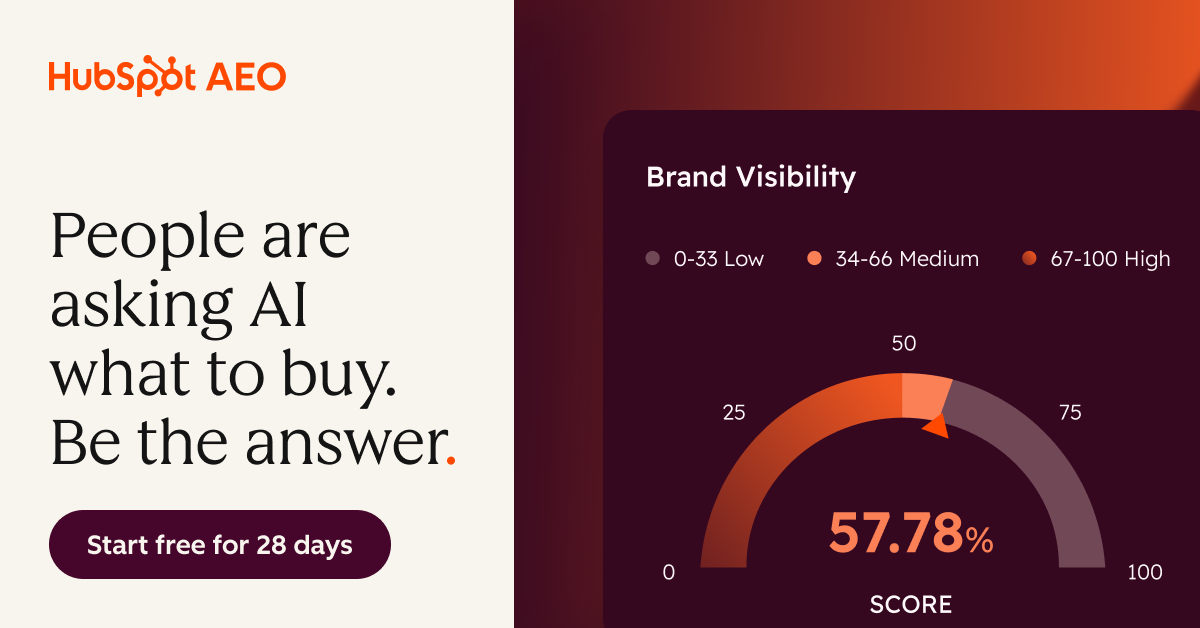
Picture this. A buyer opens ChatGPT and asks for a recommendation in your category. Your competitor’s name comes up. Yours doesn’t. And that buyer never makes it to your website.
That’s happening right now in markets everywhere. And most teams don’t know it’s happening because it never shows up in their analytics.
HubSpot AEO shows you exactly where your brand stands in AI search, where competitors are getting recommended instead of you, and tells you specifically what to fix. No expertise needed.
How to write great content with AI

Most AI-written content is…well, not that great. But it can be.
Chima Mmeje has 7 field-tested tips for getting genuinely useful output from LLMs, and none of them involve just writing a better prompt.
LLMs can’t create authority or expertise. They regurgitate the internet at the quality level you feed them. If you’re not an expert who understands storytelling, no tool is going to fix that.
1) Create a training document: Don’t ask an LLM to write cold.
Feed it a past piece you’ve written in the style you want to replicate. It now has a reference point, rather than just a vague instruction.
2) Provide context: Explain your goals, what worked in the training doc, and how you want the content structured.
The more it understands your intent, the more it mirrors your voice.
3) Create a project: Build a dedicated project in your chatbot. Load it with detailed writing guidelines and a list of things to avoid, like overused words and robotic sentence fragments.
Chima’s GPT instructions run close to 100 bullet points. That might seem like overkill, but it’s really not; it’s just quality control.
4) Add a document detailing your core offerings and values: Include a document covering your products: What they do, who they’re for, and their positioning.
This lets the LLM weave in product-led value naturally, without you doing it manually every time.
5) Write in small sections: Stop asking for 2,000-word drafts. Request one section at a time, paragraph by paragraph.
Smaller output means tighter feedback and far more control over the final result.
6) Personalize the output: This is where you weed out the generic slop.
Add your experiences, your mistakes, your results. Nobody else shares your exact story, and that’s what makes readers trust you.
7) Give feedback: After every edit, return the final version to the LLM and explain what you changed and why.
The goal isn’t perfection. Chima targets 70% quality output, then refines from there.
The full breakdown is in the original Moz post here.
Stop drowning in AI information overload

Your inbox is flooded with newsletters. Your feed is chaos. Somewhere in that noise are the insights that could transform your work—but who has time to find them?
Replace hours of scattered reading with five focused minutes. While others scramble to keep up, you’ll stay ahead of developments that matter. 500,000+ professionals at top companies have already made this switch.
The channel eating your World Cup budget has the worst ad recall
It’s World Cup week. And one chart has some uncomfortable news for your media plan.

When it comes to memory, mobile app viewers have the highest ad recall at 76%
Streaming and social media viewers tie at 69%. Meanwhile, traditional TV viewers, the audience receiving the largest share of most advertising budgets, trail the field at just 51%.
That’s a 25-point gap between the channel most brands pour money into (TV) and the channel where audiences remember the ads (mobile).
The Crew’s Take: Budget allocation and recall don’t match up.
TV commands the lion’s share of World Cup ad spend, yet mobile and streaming viewers are dramatically more likely to remember what they saw.
Want more insights like this? Pro readers get deep dives into what’s changing in today’s marketing world with data to back it up—and tips to get ahead of competitors.
MARKETING: What does a long-term brand visibility strategy actually look like in 2026? Join the online conference BreakingSilos on June 9 to find out. No vendor pitches. No generic panels. Just practitioners who’ve actually unified their brand signals. Book your free spot.*
SNAPCHAT: While the app shrinks elsewhere, India is the bright spot, now topping 250M monthly users and becoming its largest market. Advertiser numbers jumped tenfold in two years, and Gen Z brand recall beats rivals. If your audience skews young, this is one platform worth a fresh look.
YOUTUBE: The shopping experiment flopped, and product tags in community posts are getting the boot. From June 3, creators can’t add new ones; by July 3, old tags disappear from view. Posts stay live, however. Even giants fumble in-stream shopping, so test small before betting big on it.
META: Edits, the CapCut challenger, scored another weekly upgrade. You can now import outside audio, match volume across tracks, and play with over 200 new sound effects. Font search improved, too. The app stays free, making it a smart, low-risk tool to trial if video is part of your content plans.
INSTAGRAM: Skipped two-factor login? Bad news. Over 20,000 accounts got hijacked when attackers tricked Meta’s AI support tool into resetting passwords without checking emails. Meta has since killed the system and secured accounts. Treat this as your nudge to lock down every login before someone else does it for you.
LINKEDIN: Post analytics now split reach into in-network versus out-of-network, showing how much traction comes from followers versus algorithm-driven discovery. It rolls out worldwide, and document posts get a tidier carousel look. Use this to spot which posts grow your audience and which just preach to the choir.
*This is a sponsored post.
Interested in advertising in one of our newsletters?
Connect with over 100,000 of the world’s best marketers who read a newsletter by Stacked Marketer.