
It’s Friday!
And Gen Z has found the cure for doomscrolling: scrolling, but for birds. #BirdTok is booming, and one clip of a seagull eating a salmon fillet has pulled 52 million views.
Fifty-two million. For a gull with expensive taste. So maybe attention isn’t dead. Maybe it just wants to be somewhere pleasant.
Worth remembering before you write your next ad.
Microsoft and Google: Max CPC is out, AI Max is in
Both platforms spent this week swapping your manual controls for suggestions.
Here’s what actually changes.
The ceiling comes down Oct. 1: Microsoft is removing Max CPC from new non-portfolio campaigns using Target CPA, Target ROAS, Maximize Conversions, and Maximize Clicks.
Existing campaigns keep it. So do portfolio strategies. This is a template review, not a migration.
Your remaining levers are budgets, performance targets, and conversion value rules.
On the other hand, AI Max is rolling out globally on Microsoft Search with broader query matching, generated creative, and dynamic landing page selection.
It stays opt-in, ships with brand controls, and preserves settings on imported Google Ads campaigns.
Speaking of Google’s version of AI Max, it’s getting the measurement layer first.
From September, multi-campaign A/B tests for budgets and ROI targets, experiments that finally run with brand and location controls enabled, plus Performance Planner forecasts you can apply in one click.
Google’s also filling in your blanks: Customer Match is testing Enhanced matching, an opt-in setting that expands lists using consented publisher signals. Incremental reach? Unspecified.
And Google Ads now suggests sitelinks based on your final URL.
There’s also something for the content side: Google’s new Preferred Sources button turns one reader click into standing placement in Top Stories, AI Overviews, and AI Mode.
This might boost, or decrease your search engagement, too. Not by much, we think. For now.
Meta AI audits your ads, LinkedIn chops your webinars
Every platform now wants to be your intern.
Meta wants desk access: Meta AI can now work directly with your Instagram, Facebook, ad campaigns, and Google Workspace.
What does it mean? Simply ask what’s working, benchmark against comparable brands, then have it build the deck. It’ll also run recurring reports on a schedule.
It’s free to start, with a Meta One subscription once you lean on it harder.
LinkedIn is coming for your recordings: Its new Recommended Clips & Chapters auto-finds highlights in Live recordings and splits them into navigable chapters.
You refine before publishing, then push clips into organic and paid. Interesting tool.
Will users welcome these tools? Apparently so, as 87% of SMBs told Amazon Ads that AI tools unlocked channels, audiences, or formats previously out of reach. Streaming TV included.
Especially since we’re now used to AI: Pew found over a third of webpages published since ChatGPT launched show signs of AI authorship.
Em dash usage has doubled since 2023. “Delve” and friends have more than doubled too.
So the tooling stopped being the advantage. Everyone got the intern, the clip cutter, and the streaming TV placement.
What’s left is the judgment on top: what you cut, what you keep, what you refuse to publish because it sounds like everyone else.
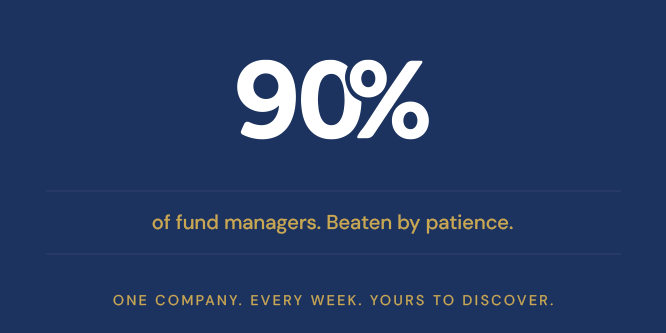
What if doing nothing beat 90% of professional fund managers?
The investment industry sells complexity. Research. Timing. Alpha.
The data tells a different story. Over any 20-year period, a simple world index fund has outperformed more than 90% of professionals. Most investors who try to beat the market end up paying more in fees to underperform it.
The edge isn’t intelligence. It’s patience.
But patience is hard when your portfolio feels abstract. A passive fund is just a ticker on a screen. The thousands of companies inside it, the businesses you actually co-own, stay invisible.
90 Percent fixes that. Every week, it pulls one company at random from the world equity index and tells you what it actually does.
- The Brazilian company that makes the electric motors inside almost everything that spins.
- The Florida company that sells your airline its spare parts at half the price.
- The Japanese hardware company hiding inside every factory.
One company. Every week. Yours to discover.
Your website is only 40% of AI search

Goran Mirkovic at WordStream makes a point worth sitting with.
Businesses optimizing for AI answers are fiddling with their own site. But that covers roughly 40% of how generative engines decide who to cite.
The rest comes from everywhere else. Here’s what’s getting ignored.
1) Earned media, minus the PR retainer: Forget Forbes. In a GEO context, earned media is any mention of your name and specialty on a property you don’t own: a trade newsletter comment, a local “best of” list, a vendor case study.
What we think: Self-reported claims are weak. Three third-party sources saying the same thing is corroboration, and corroboration is what AI models are hunting for.
2) LinkedIn is doing more work than you think: An analysis of 325,000 prompts across ChatGPT, Google AI Mode, and Perplexity found LinkedIn is the second-most cited domain, behind only Reddit, appearing in over 13% of responses.
For professional and local service queries, it’s first.
A Semrush look at 89,000 cited LinkedIn URLs found 75% of cited authors post at least five times per four weeks. Follower count barely mattered.
3) Your Google Business Profile isn’t set-and-forget: Claiming it isn’t finishing it. Categories left at the broad trade level, three-year-old photos, and unanswered reviews all leave citation opportunities on the table.
Review language expands the vocabulary AI associates with you.
4) YouTube: the signal nobody wants to hear about: Across AI search platforms, YouTube gets cited 200 times more than the next closest video competitor.
Both OpenAI and Google trained on YouTube transcripts.
The Crew’s take: Phone footage answering one specific customer question beats a polished brand video that says nothing. Transcripts, titles, and descriptions are all readable while your service page isn’t, not in the same way, at least.
5) Consistency is the tiebreaker: Mismatched cities, old phone numbers, specialties listed in one place and not another… Every contradiction adds doubt to every query about you.
Standardize one description paragraph and use it everywhere.
None of this needs a budget. It needs specificity and the patience to keep profiles current, which is exactly where most multi-location brands fall down.
The AI marketing newsletter read by marketers at Google, Klaviyo, and Morningstar

Every Saturday, the Tactics newsletter delivers one effective AI tactic, three ways to use it, and real examples that make it easy to apply.
… Because you’re more likely to succeed when you act on one clear AI strategy Monday vs. juggling five half-baked ideas and forgetting them by Friday.
And each issue takes just seven minutes to read, so you can literally go from reading to execution in minutes.
Small steps move your business forward.
Like this one: Subscribe to Tactics for free.
Creators won’t risk their reputation for quick cash
Turns out creator partnerships are a lot like dating.
Nobody wants to introduce a questionable partner to their friends, no matter how much they offer to pay for dinner.

- Quality and values lead the pack: A high-quality brand (45%) and Alignment with personal brand values (44%) sit right at the top of what creators seek in sponsored deals.
- Authenticity over easy money: Product trial for authenticity (40%) and Audience transparency (40%) prove creators prioritize keeping their credibility intact.
Creators guard their audience’s trust fiercely. Once burned, it’s impossible to buy back.
Strong brand equity makes you a magnetic partner, while questionable quality will get you ghosted by top-tier talent.
Actionable tip: Send product seeding kits with zero strings attached. Allow creators to trial your product and verify its quality before pitching a formal paid partnership.
AI MARKETING: This daily newsletter condenses the latest and greatest AI developments into a 5-minute read. They read the noise, pull out the signal, and explain what actually matters for work, strategy, and the tools your team is already using. Trusted by 700k+ readers. Subscribe right here.*
NATIVE ADS: NBC News just handed all of its global programmatic display sales, high-impact homepage banners included, to Taboola. Want automated access to NBCNews.com or TODAY.com inventory? You now go through Taboola’s Realize platform. Interesting.
TIKTOK: Sending money via DM is reportedly on the table for U.S. users, extending TikTok Pay beyond Vietnam, Malaysia and Thailand. Why should you care? On Douyin, livestreams drove over 40% of 2024 e-commerce sales. Less friction means more impulse buys mid-stream.
GOOGLE: John Mueller says spam systems like SpamBrain run continuously, while announced updates just flag the bigger, broader changes so you know why your metrics moved. The caveat is that plenty of rollouts go unannounced. That ranking dip with no update on the calendar? Still probably an update.
SOCIAL MEDIA: A spiritual successor to Vine just opened to the public with six-second looping videos, 2.5 million restored classics, and a flat ban on AI content. Built on decentralised Nostr, it’s betting nostalgia beats retention mechanics. Murmurs are it may also have ads in the future.
*This is a sponsored post.
You have me today, tomorrow you’ll have more;
As your time passes, I’m not easy to store;
I don’t take up space, But I’m only in one place;
I am what you saw, But not what you see.
What am I?
You can find the answer here.
Interested in advertising in one of our newsletters?
Connect with over 100,000 of the world’s best marketers who read a newsletter by Stacked Marketer.