
Good morning.
We made coffee. We drank it. We made more. We drank that too.
Might make a third cup.
Just another day in the life, you know?
Google gives Discover a follow feature and sunsets an API, and ChatGPT search gets improved
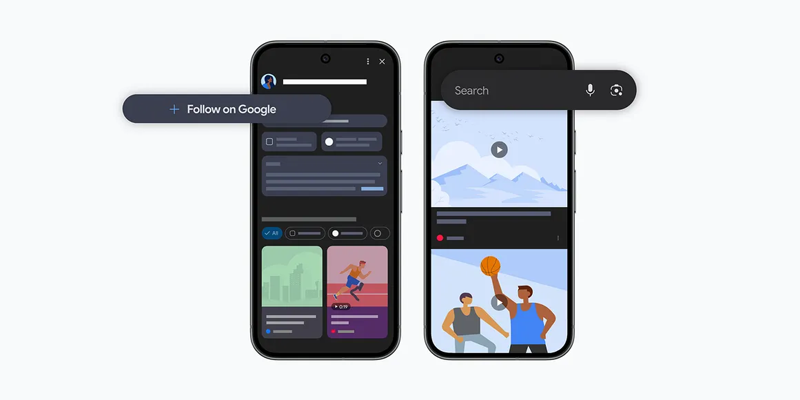
They came, they saw…
They subscribed: Google Discover is rolling out a follow feature that lets users subscribe to their favorite publishers.
Hopefully this means more of your articles, videos, and social posts land directly in their feeds. Fingers crossed.
Answering for the last time… Also, wave goodbye to the My Business Q&A API. Google is discontinuing the feature on November 3, 2025.
Keep in mind that while the API is sunsetting, Google says it’s updating the Q&A user experience. We suggest saving your data in the meantime anyway, just in case.
Searching for a better search: Over at OpenAI, ChatGPT’s search function just got an upgrade.
OpenAI claims its update produces fewer hallucinations, improved shopping intent, and better formatting.
We certainly hope so.
Back to the SERP: Even as publishers are suing over lost traffic, a Google executive recently defended AI Overviews, claiming they’re simply meeting user preferences.
Yeah, they’re not going anywhere. In fact, Google is testing more AI-generated summaries under each search result snippet.
Is that really what users are asking for… or is Google using this as a cover?
Either way, plan accordingly.
Amazon launches an agentic ad tool, and Best Buy expands its ad offerings
If your creative team is currently powered by nothing more than the will to continue and lukewarm coffee…
Here’s a suggestion: Amazon Ads has a new agentic AI tool that acts like a creative strategist by helping you produce professional-quality ads in a few hours at no extra cost.
This conversational AI uses Amazon’s retail data to research products, brainstorm concepts, and generate storyboards for both video and display ads across Amazon Ads offerings.
Maybe explore it with the team over lunch. It could give you the creative edge you’ve been wanting.
If you build it… Meanwhile, Best Buy is expanding its own retail media arm. It just announced new ad tech features and strategic partnerships with media brands, and even the NFL.
Best Buy is also launching in-store takeover packages that put you in front of customers online and off, and unlocking real-time audience data modeled for specific campaign goals.
Is this an opportunity to go beyond selling products to selling across the entire customer journey? Maybe.
Might be worth exploring if your or your clients’ brands are in retail…
Claude for marketers: 60+ prompts that do the heavy lifting

==Image==
Streamline your marketing with 60+ Claude prompts built to save time, spark better content, and surface new growth opportunities.
- Actionable Claude strategies to boost output across your funnel
- Faster content creation, sharper insights, and smarter dashboard builds
- Real examples from marketers using Claude to scale results
- A framework to plug Claude into your daily workflows
Don’t just keep up with AI, start making it work for you.
Why marketers need to rethink ROAS as their northstar metric

==Image==
“Hey, how are the campaigns doing?” the CEO asks.
You share the 4:1 ROAS, and everyone relaxes. They even celebrate.
… But what if that number is basically meaningless?
Brooke Osmundson recently offered a reality check on key performance indicators (KPIs)… namely ROAS. And she argues it might be time to rethink what success really looks like.
The painful truth: Return on ad spend seems straightforward, but it often rewards you for targeting existing customers.
That isn’t growth, it’s maintenance.
It also completely ignores crucial factors like profit margins and operational costs. A great ROAS could still be losing money or even throttle spend.
ROAS isn’t useless, of course. It’s a helpful diagnostic tool for comparing performance between campaigns, evaluating short-term promotions, and reviewing efficiency.
But you should use it to see one piece of the story, not the whole narrative.
When leaders make it the only metric that matters, teams over-index on easy wins at the cost of sustainable growth.
We need new North Stars. The question is, if not ROAS, then what?
The right North Star ultimately depends on your business, but here are a few better candidates for measuring long-term health:
1) Customer lifetime value (CLV) to CAC ratio. This shows if you’re building a sustainable business and forces you to think beyond the first purchase.
2) Incremental revenue. This helps you understand what paid media is adding, not just capturing. Use tests to filter out conversions that would have happened anyway.
3) Payback period. This measures how long it takes for a campaign to break even. It allows you to fund top-of-funnel efforts with confidence.
4) New customer revenue growth. This keeps your marketing focused on expanding market share, not just retargeting people who are already in your orbit.
The biggest issue is often organizational misalignment. A CMO sets a simple ROAS goal. The execution team then optimizes for the most efficient, low-risk campaigns to hit that goal.
As a result, top-of-funnel efforts stall and new customer growth plateaus. Leadership is left wondering why they aren’t growing despite a “great” ROAS.
The solution is a layered KPI framework. Use short-term metrics like ROAS and CPA for daily optimization, and long-term KPIs like CLV for annual planning.
It’s tempting to lean on simple metrics that look good in a report. But if your real goals are growth and stronger customer relationships, you need to look deeper.
For all the juicy details, you can read more of Brooke’s thoughts here.
Want to see how the top e-commerce brands build highly profitable funnels?

==Image==
The easiest way to optimize your funnels for conversions is to adopt the strategies used by the 11 top e-commerce brands.
Our E-commerce Acquisition Funnels Deep Dive shows you:
- Customer journey paths with a solid conversion record.
- Effective timing strategies that increase the likelihood of purchases on your offers.
- The kind of social proof that nudges buyers from “maybe” to “yes.”
And more!
Get instant access with a 7-day trial of Stacked Marketer Pro.
Is the marketer’s job becoming more complex?
Let’s go back in time, all the way back to 2020 or 2021.
According to reports, the average marketing team managed seven marketing channels in 2021 and were expecting they’d manage 8.5 today.
Now fast forward to the present:

==Image==
Today, you’re expected to manage close to 10 marketing channels.
And the average number of marketing channels per business is expected to rise to 15 soon.
Also, back in 2021, marketers had about five tools in their tech stack on average. They expected to add one or two more in the next couple of years.
Today, the average is 11… and it’s expected to rise to 16 in two years.
Oh, one more thing. In 2021, marketers worked with four marketing product or service providers… and now it’s close to six and expected to rise to 7.5.
Piling on the pressure: Amid the increasing complexity, the data also proves that teams must do more with less, because budgets simply are not keeping pace with expectations.
This is one of the key reasons why so many marketers are experiencing burnout.
And that’s something we wrote a lot about a few months ago. You can read the entire report here. Don’t worry, it’s not all doom and gloom!
We’ve got good tips in there for you, too. Because you deserve a break.
GROWTH MARKETING: Successful brands don’t only focus on big ideas—they focus on small, incremental improvements to their marketing that compound over time. Want to score compounding wins like them? Tactics delivers one proven idea on every Saturday you can implement by Monday. Get it for free.*
INSTAGRAM: … Just added the ability to convert clips into overlays, gain more control over fade speeds, and save sound effects, which should make it easier than ever to make engaging videos and establish branded settings you can return to in the future. Pretty cool.
LINKEDIN: That verification checkmate for your company page just became more accessible, even without a Premium subscription. LinkedIn is expanding eligibility to pages with high engagement or an existing commercial relationship, like running ads. If you want a quick and easy way to build trust, get verified!
SNAP: If you think new parents are too busy for social media, think again. A new report found that 59% of parents use social platforms more after having a child. Many shop with their kids, which makes them a more engaged and lucrative audience than you might assume.
AI MARKETING: A new Pew Research survey suggests your audience probably isn’t as hyped about AI as you are. Half of US adults are more concerned than excited about its use and believe it will ultimately harm human creativity and connection. Which side are you on?
TIKTOK: The platform’s future in the US is firming up with a—reportedly—majority American ownership that includes Oracle. In other words, you may see users pushed to a brand new standalone app built specifically for the US market, with Oracle handling the data. Here’s hoping it’s a smooth transition…
*This is a sponsored post.
I am a three digit number.
My tens digit is five more than my ones digit. My hundreds digit is eight less than my tens digit.
What number am I?
You can find the answer here.
Interested in advertising in one of our newsletters?
Connect with over 100,000 of the world’s best marketers who read a newsletter by Stacked Marketer.