Happy Monday.
Ever had that feeling at the start of the week that it’s just going to be a good one… for no particular reason? We have it today.
No data to back it up, of course. Kind of like when you test a new campaign on vibes alone and it just works. Let’s see if the news follows the same mood…
Meta’s “Forum” and TikTok Shop’s success prove the same thing: Community sells
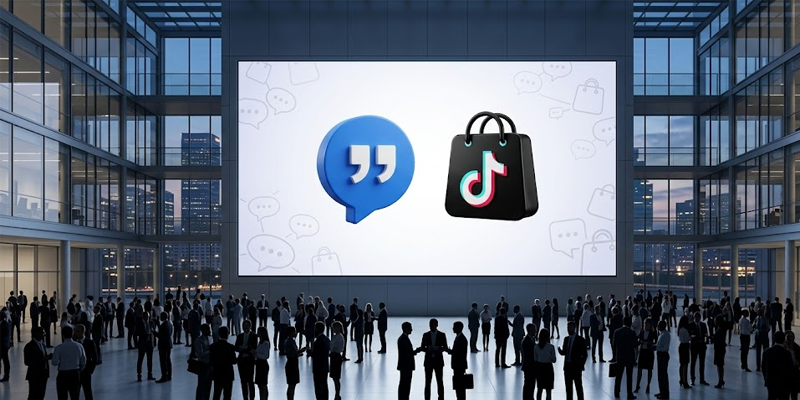
Word of mouth is getting a group chat.
Where are your customers lurking? Forum is Facebook’s new standalone app where the only thing in the feed is the conversation.
What this means: Meta wants group discussions to compete with dedicated community platforms. And built-in AI search lets users pull answers from every group they’re in at once.
This means years of niche knowledge, tutorials, and recommendations to the surface instantly.
Plus, real names mean real accountability, which could make it a less chaotic environment than Reddit.
If Forum finds its footing, an active Facebook Group could be where someone finds you before they ever think to Google you. Not bad.
And the experiment is over: TikTok Shop crossed $14B in US sales in 2025, surpassing Etsy, Wayfair, and eBay.
The engine behind it is creators, specifically, ones who feel like real people.
Seven in ten TikTok Shop buyers bought something because a creator told them to, and smaller brands are making gains simply by showing up genuinely on camera.
TikTok’s product discovery looks like this: people come for entertainment and leave with things in their cart.
And with formats like countdown bidding and shoppable photos mean the surface area for selling is only getting bigger.
Why we care: Both Forum and TikTok Shop are proof that the conversation happening around your brand is worth more than the content you’re putting out. Think about it.
YouTube is now the top product discovery platform
Gen Z are no longer asking their Mom. They ask YouTube.
And so does everyone else: 2.58B people use the platform every month, and a surprising number of them are shopping.
The average session runs 14 minutes and 29 seconds, nearly double TikTok’s. That’s 14 minutes of someone actively looking for what to watch, buy, or trust.
A few numbers worth knowing:
- 200B daily views on Shorts, with trending ones running for 50-60 seconds.
- 84% of Gen Z have a YouTube account, and YouTube ads are more likely to drive a purchase than TikTok or Facebook.
- 24% of users go to YouTube specifically to find new products, making it the #1 platform for product reviews across every generation.
- 56% of companies plan to spend more on YouTube in 2026.
- In-feed ads hit a 1-3% CTR vs. a platform average of 0.65%.
At this point, YouTube might be one of the most effective places to reach people who are ready to spend money. It’s where Gen Z goes to figure out what’s worth buying.
With more than half of brands planning to increase their YouTube spend next year, moving first will give you the most room to stand out.
Sprout Social’s full breakdown can be found here if you want to go deeper…
This brand boosted AI referral traffic 429%. Here’s the tool behind it

Search isn’t just Google anymore. ChatGPT, Claude, and AI Overviews are quietly siphoning off the clicks you used to count on, and most SEO tools weren’t built to track any of it.
That’s the gap Semrush One closes. It merges keyword-based SEO with prompt-level AI search insights, so you can see exactly how your brand shows up across Google, AI Overviews, and LLM answers. All in one platform.
The data backing it is unmatched:
- 239M+ LLM prompts tracked globally
- The largest ChatGPT prompt database in the US
- AI-powered next steps built for marketers, not analysts
Stacked Marketer readers get an exclusive 14-day Semrush One Starter trial.
Claude Cowork is not Claude Chat; here’s how to use it

Some marketers treat Claude Cowork like a fancier chat window. But that’s kind of like using a Swiss Army knife to open mail.
Claude Chat is great for thinking and drafting. The problem? Everything stays in the cloud and you still have to copy, paste, and organize it yourself. With Cowork, you can skip all that.
It’s a local desktop agent that reads your files, connects to your tools, and saves finished outputs directly into your folders. Here’s how to set it up properly as a marketer.
Start with a folder structure. Create a main marketing folder with three subfolders: Context (brand knowledge), templates (reusable formats), and projects (outputs).
Then open Cowork’s Global Instructions and add one or two rules, something like “always scan the context folder before starting.”
Keep it simple. Over-specifying will make Claude rigid. Let Claude build your brand context for you.
Load the marketing folder, then ask Claude to create three files: A brand context doc, a brand voice guide, and an ideal customer profile.
It will interview you with questions. Answer them, and from that point forward, Claude already knows your brand, no need to re-explain it every session.
Our take: This setup step is the difference between a generic output and one that actually sounds like you.
Use Projects for recurring workflows. Content creation, carousels, lead magnets, anything you repeat weekly belongs in a Project. Set the instructions once.
Every time you return, Claude already knows the brand, the structure, and where to save everything.
Connectors unlock live data and pull competitor social posts via a web scraping tool.
They read Gmail reports and turn them into Gamma presentations. Scrape AI search results across Google, ChatGPT, and Perplexity, then track them week over week in a spreadsheet.
The bottom line: Static files are just the starting point. Connectors are where Cowork earns its keep.
Schedule the workflows you’d otherwise forget. Weekly content briefs, monthly reports, competitive digests. Cowork can run them automatically on a set schedule.
Combine that with live artifacts (persistent, auto-refreshing dashboards pinned to your sidebar), and you’ve essentially built a self-updating marketing control center.
Seriously, we recommend watching the full walkthrough here.
The AI event for strategists: BreakingSilos 2026. Join for free on June 9th

Top marketing teams aren’t winning AI search by optimizing channels.
The brands pulling ahead in AI search are doing something different: they’re building visibility ecosystems where SEO, social, PR, content, and brand reinforce each other. And AI is citing them for it.
BreakingSilos 2026 is an online conference where the practitioners building those ecosystems share exactly how.
Most users think of AI as a search engine
If search is the engine, AI is the high-performance fuel.
Users are increasingly leaning on these tools to cut through the digital noise and handle the mental heavy lifting of their daily lives.

Bad news for Google? Over half of users (56%) use AI tools as a primary source of information, effectively treating it like a search engine. That’s a lot.
50% utilize AI as a creative collaborator for brainstorming and overcoming blocks, meaning search is now part of the “making” process.
45% see it as an everyday assistant for handling calendars and automating tasks, proving that AI is sticking its nose into every part of the user journey.
We can call this an “Integrated Discovery.” Users are looking for both facts and solutions that help them do things.
Information and utility are of equal value. If you can offer tools, calculators, or templates that AI can suggest to a user during their “creative collaboration” phase, you may win.
AI is rewriting the rules of search discovery, but Pro subscribers don’t panic.
AI EDUCATION: ChatGPT, Claude, Gemini, Midjourney… So many names, but what’s actually useful for you in your work? There’s a newsletter called The Deep View that exists to sift through all the noise and get you up to speed on what’s actionable with AI products, and it’s free. Join 512,000+ subscribers with one click and let AI empower you.*
LINKEDIN: The video tab and carousel are rolling out to Canada, the UK, and Australia after a year of testing. If your audience lives in those markets, your video strategy needs to be ready before the feature arrives.
GOOGLE: Universal Cart lets shoppers buy across Search, Gemini, YouTube, and Gmail through Google Pay in one go. However, nearly three in four Americans don’t trust AI with their shopping data. Can we blame them?
TIKTOK: After losing its TikTok bid, AppLovin launched a social app called Gist, blending TikTok, Lemon8, and RedNote into one. It’s invite-only for now, but it is a quiet launch worth watching.
*This is a sponsored post.
Two mothers and two daughters go to a pet store and buy three cats. Each female gets her own cat. How is this possible?
You can find the answer here.
Interested in advertising in one of our newsletters?
Connect with over 100,000 of the world’s best marketers who read a newsletter by Stacked Marketer.