Good morning.
Rare good news you can literally breathe in: Europe’s air quality keeps improving, with major pollutants steadily dropping thanks to EVs, cleaner energy, and decades of policy that actually worked.
Go ahead, take a deep breath. Feels nice, right? Now exhale slowly, top off your coffee, and dive into today’s newsletter. We promise it’s just as refreshing.
ChatGPT’s ads get a reality check while regulators start writing the fine print

You were promised an AI gold rush, yet nobody mentioned the map’s still being drawn.
Big number, bigger asterisk: OpenAI wants $100B in ad revenue by 2030, but Emarketer sees the entire US chatbot ad market topping out at $5.41B.
Its ad business is on pace to miss its own forecast by 90%.
Early days though: ChatGPT Ads Manager is quietly adding new features, this time Attributed Sales Value and Sales ROAS, plus product-level reporting.
Interestingly, retail-grade metrics are arriving before basics like CvR. Hm.
And a citation isn’t a click: New Bocconi research finds ChatGPT refers out in just 5.2% of sessions versus Google’s 31.1%, so being named in an answer may rarely send anyone your way.
Our take? Users expect to stay on the chatbot and find all answers in its interface. Which also might be a reason why ChatGPT ads aren’t as effective at the moment.
It’s a matter of trust, too: Only 28% of Americans trust AI search versus 70% for search engines, and heavy AI users are the ones most likely to click through and verify. Be the source they find.
And the receipts may become mandatory: Germany’s ZAK regulator ruled Google’s AI Overviews and Perplexity are content providers, not neutral pipes, and subject to media law. Google’s appealing.
We’’ll keep sharing the bits and pieces of the “AI gold rush” map as they come.
Google turns your searchers into image generators, and YouTube spells out what “slop” means
Google Images just blew out 25 candles, but its birthday gift is aimed squarely at you.
Picture this: Google is adding image generation into AI Overviews via its Nano Banana model, so searchers can now conjure a custom visual instead of finding yours.
A new personalized Images gallery arrives too, so treat it as a fresh discovery surface.
Show me the receipts: Merchant Center is piloting an AI Performance report revealing how your products surface in AI Mode and AI Overviews, plus share of voice versus competitors.
The catch? It’s organic-only, and there’s a loud silence on clicks, just impressions. It’s US-only now, but more countries are coming soon.
Frequency, but make it efficient: YouTube reach and frequency optimization for video campaign groups went global.
What you can do? Coordinate delivery across campaigns to hit that sweet spot. Google clocks 2.7/week at a 19% ROI lift.
Also, know your lines: YouTube clarified its inauthentic content policy, naming three demonetizable categories: generic/repetitive, unsatisfying/off-putting, and AI “experts” on health, legal, or money topics.
It’s not a new rule, just clearer language. If AI touches your content, add a transformative spin.
Partnership marketing meets the age of AI-powered search and chatbots

As AI-powered search and assistants reshape how consumers discover brands, partnership marketing is becoming even more valuable.
Trusted publishers, creators, influencers, and media partners are increasingly influencing buying decisions, even when those journeys don’t end in a click.
Awin’s latest AI-powered innovations help brands understand and measure this evolving landscape.
Here are just some highlights:
- Connect your brand with trusted partners who influence consumers across the buying journey.
- AI Visibility reveals when and how brands appear in AI-driven experiences, including the role partner content plays in discovery.
- Through a partnership with ScalePost, Awin measures real AI citations using first-party data for more accurate insights.
- Smart Search helps advertisers find and recruit the right publisher partners faster using natural language prompts.
The lessons from trying to refresh hundreds of blog posts using AI
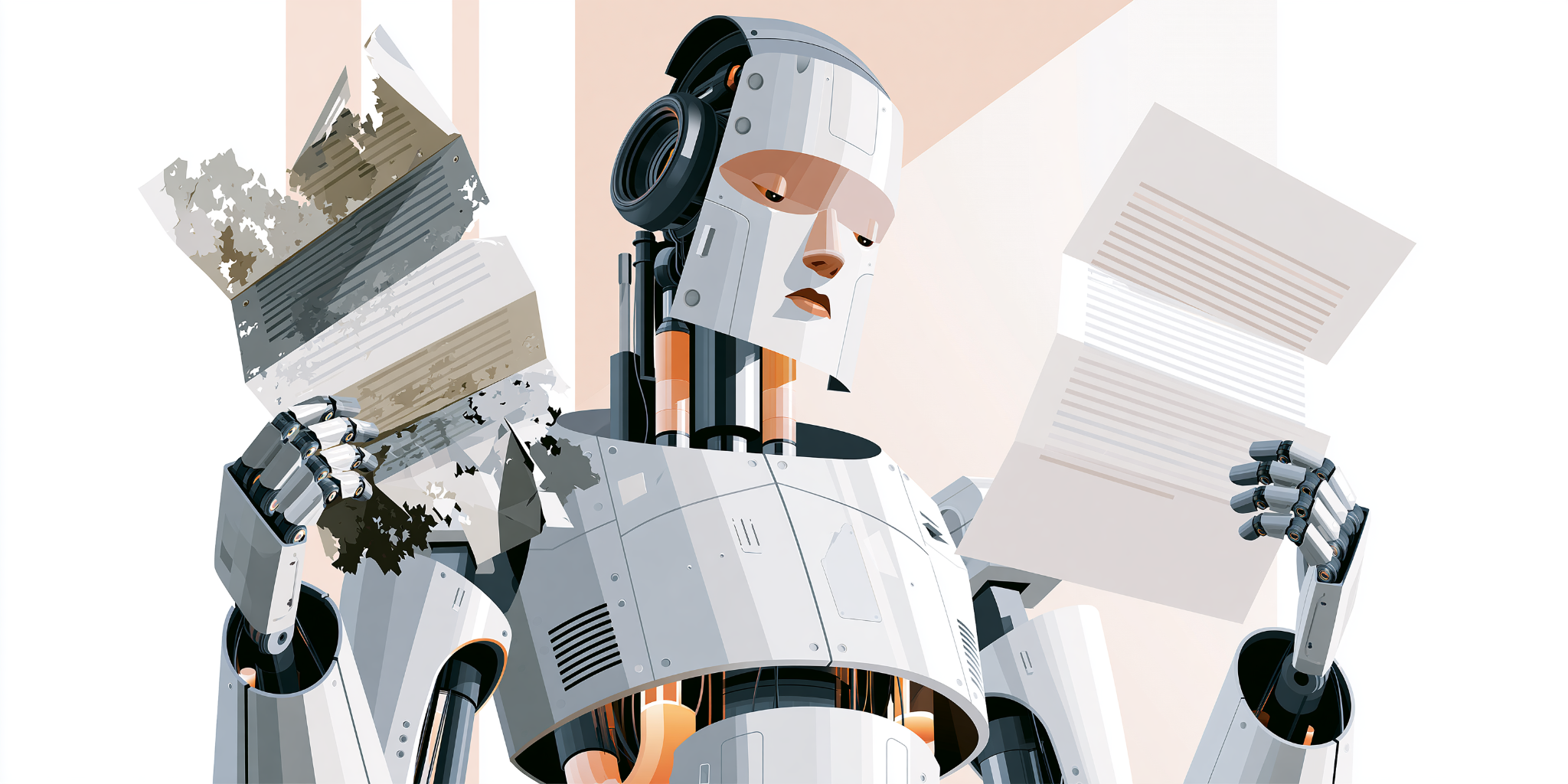
Semrush’s Carlos Silva had a backlog of hundreds of blog posts to keep fresh, so he built an automation to handle it. The research half sang. The drafting half flopped.
Here’s what he and his team learned when they rebuilt the whole thing.
1) Automation is great at fetching, terrible at deciding. Workflow tools like n8n are great at chaining API calls: grab this, transform that, pass it along.
But in the end, drafting an article is a judgment call about voice, structure, and what to leave alone. If your AI is one cog in a rigid pipeline, don’t be shocked when it writes like one.
2) Bad drafts don’t fail politely: The old setup served up fluffy prose, ignored the style guide, and worst of all invented product features that don’t exist. In convincing detail.
Every fix such as new models or tighter prompts produced one decent draft, then broke in a fresh new way.
It’s like the one thing AI is as good as humans at, it’s hallucinating. But that’s not the end.
3) Context beats clever prompting: The breakthrough was giving the AI everything at once: the original article, the style guide, past drafts, and the research. All in one folder.
Suddenly the drafts sounded like Semrush.
You can’t prompt your way around missing context. Feed the machine properly, and it stops guessing.
4) Save every step as a file: The rebuilt pipeline runs nine Claude skills, and each one saves its work before the next begins.
When a hallucination slips through, a reviewer opens the side-by-side diff and fixes it in about a minute, not twenty.
5) Three runs, not three months. Months of tweaking the old system never nailed the voice. Three runs of the new one did.
The drafts now arrive with only the small edits any writing needs, not the structural disasters of before.
If you’re stuck at a quality ceiling, look at where your AI makes its writing decisions. If that’s buried inside a workflow step, that’s your ceiling.
Move drafting somewhere the AI can read your files directly.
We recommend reading the full piece, because it’s a very insightful and truly practical use case for Claude or your other favorite AI.
Smart marketers read smarter news

Understanding the economy sharpens your marketing instincts—no doubt about it.
But let’s be honest: most business news feels like a chore to read. (Think: filing taxes, but with more jargon.)
That’s where The Daily Upside stands out. It’s sharp, insightful, and yes—actually enjoyable.
The Daily Upside delivers sharp, market-moving stories with clarity, wit, and zero filler.
It’s the kind of intel that helps you make faster, smarter marketing and business decisions.
Where Marketers actually use AI?
AI has become the Swiss Army knife of the modern marketing team.
But some “blades” are getting more use than others…
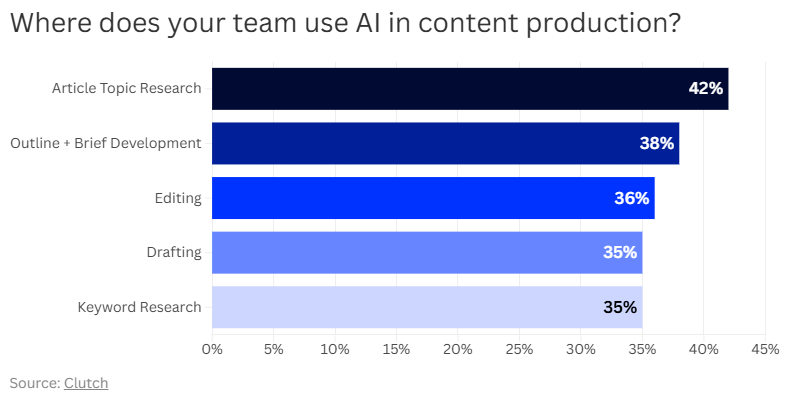
It appears that marketers are leaning on AI most heavily during the early stages of the content lifecycle.
Article topic research is the number one use case at 42%, followed closely by outline and brief development at 38%.
- Editing (36%): Using AI as a second pair of eyes.
- Drafting (35%): Getting the first 500 words down.
- Keyword Research (35%): Tied with drafting for SEO-focused tasks.
All these numbers show AI is firmly embedded in the “grunt work” of content production.
AI is excellent at “breadth” (researching and outlining) but still requires a human for “depth” (the actual final draft).
So it can’t be your creative director, but it is sure likely to be your creative assistant.
Use AI to generate 20 “out-of-the-box” topic ideas based on a single keyword. You’ll likely discard 18, but the remaining two could be angles you never would have considered.
AI MARKETING: This daily newsletter condenses the latest and greatest AI developments into a 5-minute read. They read the noise, pull out the signal, and explain what actually matters for work, strategy, and the tools your team is already using. Trusted by 700k+ readers. Subscribe right here.*
SOCIAL MEDIA: Ever feel like your X replies are a warzone? The platform tweaked its algo to surface mutuals more, so feeds cluster around shared interests. It’s a broader shift. Threads is chasing the same community angle as platforms pivot from chaos toward connection.
SOCIAL MEDIA: Speaking of shifts… A survey of 1,000 Americans found over half now post less than five years ago and guard who sees what. Maintaining a presence feels like work, and politics is chasing people off.
META: Advantage+ tools are auto-enrolling brands and spitting out garbled copy, warped products, and extra limbs. Meta’s stance? Reviewing outputs is your job. Since a buggy toggle can flip AI back on, audit every campaign before it runs under your name.
INFLUENCER MARKETING: Pew data shows 57% of US women aged 18-29 get health and wellness info from influencers and podcasts. Beauty and alternative medicine content dominates their feeds, so if you’re in wellness, you now know exactly which creators to court.
GOOGLE: A fresh class action from book publishers and authors accuses Google of feeding copyrighted books into Gemini without permission, including titles handed over for Google Books. Not the first time someone is accusing Google of copyright infringement.
*This is a sponsored post.
You throw away the outside and cook the inside. Then you eat the outside and throw away the inside. What is it?
You can find the answer here.
Interested in advertising in one of our newsletters?
Connect with over 100,000 of the world’s best marketers who read a newsletter by Stacked Marketer.