Good morning.
Bad news. Someone caught Agatha Christie using AI to write her novels.
The evidence? Em-dashes everywhere, plus the classic “No X. No Y. Just Z.”
Guilty as charged, all the way in 1936. A finding that Christie’s own Poirot would be proud of.
Or maybe, just maybe, AI writes like Christie because it… read Christie? Nah. It’s all AI. If nothing, it’s better for the plot.
Meta hands you chatbot receipts, pulls an AI tool, and faces an EU redesign
Somewhere in Menlo Park, they had a very long weekend…
Finally, some homework you’ll enjoy: Meta added new Business Suite metrics for its custom chatbot agents on Messenger and WhatsApp.
You now get containment rate, contact with intent to buy, and total AI conversations. In other words, proof your DM bot is earning its keep.
Worth logging before Meta starts charging for these tools, which looks increasingly likely.
Here today, gone tomorrow: Meta also scrapped Muse Image days after launch, following a privacy backlash over auto-opt-in.
Users and SAG-AFTRA weren’t thrilled it referenced public Instagram photos without a clear yes first.
The lesson for you: shiny new Meta AI features can vanish fast, and consent expectations around AI content are tightening.
And the big one: A preliminary EU ruling says Instagram and Facebook breach the Digital Services Act over “addictive” design.
Meta may be forced to disable autoplay and infinite scroll by default, and make its algorithm less engagement-oriented.
If it sticks, EU reach and time-on-platform for your content could shift under your feet.
Keep one eye on Brussels. What Meta’s forced to change there tends to ripple everywhere else.
Platforms are drawing new lines around AI content and scam ads, and more
Everyone wants to police AI right now. They just can’t agree on how.
TikTok is playing hall monitor: It’s labeled over 3 billion videos as AI-generated (AIGC) and is testing detection to purge AI-spam accounts in politics, finance, and medical topics.
In short, more oxygen for original creators, and AI transparency is officially table stakes.
Instagram’s taking the opposite tack. Adam Mosseri says AI content should be labeled, not filtered, you won’t get an off switch, but you will get an “is this AI?” tag.
The upshot for you: AI-generated content stays viable across feeds. Just expect it to wear a name badge.
Outside of AI, YouTube wants you binge-worthy: Partner Program creators can now turn playlists into structured shows with seasons and episodes.
Why does this matter? Shows can surface in search, “Recommended shows,” and “Continue watching”. That’s a fresh discovery lane for repackaging if you create YouTube content.
Meanwhile, the regulators are circling: Ofcom wants Instagram, TikTok, YouTube, Pinterest, X, and others to crack down on scam ads or face fines up to £18M or 10% of global turnover.
The catch: enforcement likely won’t bite until 2027.
The free growth playbook that teaches you how to unify every conversion signal and master omnichannel data on Meta
Elevar’s strategic playbook with Meta arms marketing leaders to close the signal gap and drive omnichannel growth.
This guide outlines the data foundation your teams must own—server‑side forwarding, robust identifier coverage, deduplication, and timely offline event delivery—so Meta’s optimization works for your full business, not just ecommerce.
With this playbook, you will learn how to:
- Raise Event Match Quality and Offline Data Quality toward the 8.5+ benchmark
- Improve match rates
- Align campaign structure and creative to prioritize high‑value customers across online and in‑store touchpoints
With BFCM approaching, you must stop improvising and ensure infrastructure is in place to let platform AI allocate spend with confidence.
Download the Elevar + Meta Omnichannel Ads Playbook for a concise roadmap, executive checklist, and implementation priorities you can brief your teams on today.
Take control of your signals, validate incrementality, and make peak‑season decisions with clarity.
Slapping an “AI” label on your content could tank your engagement

Another week, another fresh research from the team over at Science Says.
This time they dug into whether people clock the “made with AI” label. And whether using it might harm your brand reputation?
Turns out it’s a “yes” for both.
Across 8 experiments and over a million TikTok posts, researchers found AI-disclosed content pulled in 7-8% fewer likes and 7% lower combined engagement.
The real kicker? This happened even when the quality was identical.
Same content produces worse numbers, purely because of a tag. Rough trade.
It’s not just the metrics. It’s how people see you: when audiences spotted the AI label, they assumed creators put in 15.6% less effort and felt 14.5% less connected to them.
Why this matters: Engagement runs on the belief that a real human sweated over something. Strip that perception away and the relationship cools fast.
That’s why the penalty vanishes when the AI looks hard to use. When the tool was seen as complex and effortful (think Photoshop Neural Filters), the hit disappeared.
Effort is the currency, not the tech itself.
Some limitations: The research only covered creator content. For AI-native accounts, technical announcements, or institutions where connection isn’t the point, the penalty may not apply.
So what do you actually do? Don’t hide the AI. Frame it. Show the human graft behind it: “We spent 20 minutes on this visual and used AI for the special effects.”
One last thing worth sitting with: we tend to give ourselves a pass on AI while judging everyone else for using it.
Assume your audience is holding you to the stricter standard.
The AI marketing newsletter read by marketers at Google, Klavyio and Morningstar

Every Saturday, the Tactics newsletter delivers one effective AI tactic, three ways to use it, and real examples that make it easy to apply.
… Because you’re more likely to succeed when you act on one clear AI strategy Monday vs. juggling five half-baked ideas and forgetting them by Friday.
And each issue takes just seven minutes to read, so you can literally go from reading to execution in minutes.
Small steps move your business forward.
Like this one: Subscribe to Tactics for free.
How can AI close the tactile gap in e-commerce?
Love it, hate it, AI is becoming a shopping wingman.
And shoppers are increasingly looking for “smart” features that remove the guesswork from their digital shopping carts.
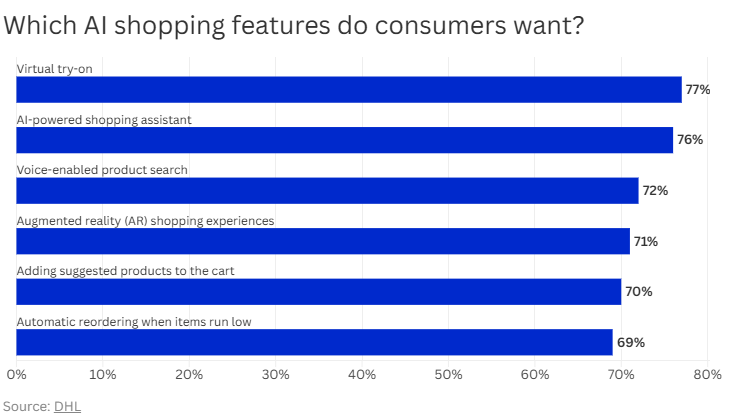
The trends are interesting:
- The most wanted feature is virtual try-on (77%), as shoppers want to see how that hat looks before they commit.
- 76% want an AI-powered shopping assistant to help them navigate choices.
- 69% are interested in automatic reordering, showing a high demand for “set it and forget it” convenience.
What this means: Online shopping still has a sensory problem. But when you offer virtual try-ons and AR experiences, you’re reducing the psychological risk of a bad buy.
On top of that, providing convenience like automatic reordering or adding an AI assistant can help you overcome the biggest hurdles during the consideration stage.
Now all that’s left is to actually implement this…
AI MARKETING: This daily newsletter condenses the latest and greatest AI developments into a 5-minute read. They read the noise, pull out the signal, and explain what actually matters for work, strategy, and the tools your team is already using. Trusted by 700k+ readers. Subscribe right here.*
E-COMMERCE: TikTok’s June policy round-up for sellers and creators tightens the rules you’ll build campaigns around. Discount and pricing claims, health and weight-management language, and review requests all face new compliance guardrails. Incentivized reviews and misleading price hooks are squarely in the crosshairs.
GOOGLE: Ever spend on upper-funnel ads and have no clue if they worked? Google’s new Gemini-powered metric, Qualified Future Conversion, forecasts sales up to 180 days out by linking early signals like brand searches to future revenue. It’s in limited testing now, with wider rollout later this year.
DISNEY: Feeling YouTube’s grip on the living room, execs are quietly floating a free, ad-supported tier for Disney+. Free streamers now claim nearly 19% of US TV watch time, so expect a no-cost gateway to older catalog titles and fresh ad inventory you might soon be buying into.
GOOGLE: Fixed your duplicate content but the cluster won’t budge? Google warns that re-evaluation can take up to two weeks after a content fix. The clearer the difference between pages, the faster they split, so make those distinctions obvious. Save Request Indexing for your top URLs.
*This is a sponsored post.
Two sisters we are, one is dark and one is fair,
In twin towers dwelling we’re quite the pair,
One from land and one from sea,
Tell us truly, who are we?
You can find the answer here.
Interested in advertising in one of our newsletters?
Connect with over 100,000 of the world’s best marketers who read a newsletter by Stacked Marketer.