
Good morning.
Apparently, some people can thrive on 4-5 hours of sleep every day. They wake up refreshed. Energized. Ready.
If you’re one of the lucky few, please tell us your secret. We’ll be over here, on cup number three.
Just in: YouTube insights, advanced ad features for Meta, and more creation tools for TikTok

YouTube’s picking up on hints.
Reading the room: Google announced at Cannes Lions that you can now see new trending insights on the platform in Google Ads Insights Finder.
This means you can search what’s gaining traction by topic, location, and demographic.
You can also get fresh data on creators open to brand partnerships and Gemini-powered tips for Demand Gen Campaigns. Insights Finder is still in beta, though, so you’ll need to apply.
Real performance data beats guessing every time so use it to shape your strategy.
And Meta wants to close the loop: Its new end-to-end creative solution in Ads Manager lets you test AI-generated ads tuned to your brand’s actual tone and style.
The idea is to learn what’s performing, generate more of it, then test again, so your next creative move is backed more by data and less by vibes. It’s rolling out to select advertisers first.
Meanwhile, TikTok skipped the camera entirely: Its new Symphony Agent builds whole video campaigns from a single text prompt.
It reads what’s already trending in-app and works from there. Feed it cues, images, or example videos, and it serves up similar high-performers you can riff on.
If you prefer a blank canvas, it can build from scratch on ByteDance’s Seedance 2.0 model.
Results will vary, but the inspiration alone is worth a look.
Snapchat highlights its user engagement, while Pinterest showcases in-app trends
Snapchat says its users just love hanging out there.
Time well spent, allegedly: The platform has shared a new report arguing that its users are uniquely primed to welcome your brand.
The Snap-commissioned study claims roughly three in four users consider their time on the app “meaningful,” the highest score among major platforms.
It says people open Snapchat to connect with someone they care about, and that intentional mindset makes them more receptive to ads.
Snap says promotions in this environment see better unaided recall, stronger favorability, and more purchase impulse, with added lift when paired with Facebook video campaigns.
But take it with a grain of salt. Snap hasn’t published the question framing behind that “meaningful” stat, so treat the halo with an asterisk.
Less URL, more Croisette: Meanwhile, Pinterest is courting the people who actually hold the budgets, hosting its fourth Manifestival at Cannes Lions this week.
The activation turns trends into tangible experiences like a tattoo parlor, a patisserie, an Adobe-powered visual search studio, and a Sephora beauty collab.
It’s all in service of Pinterest’s “Less URL, More IRL” branding, designed to tie the app to real-world cultural moments rather than fleeting feeds.
With 631M users mostly arriving in a shopping mindset, this trend-led positioning can help.
Save 40+ hours on influencer sourcing and campaign management
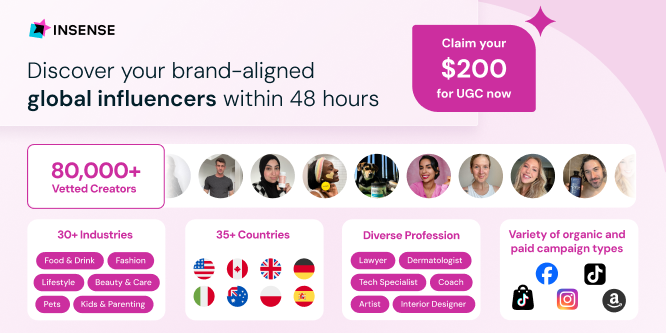
Your best creators aren’t in your inbox. They’re ghosting it – costing you valuable time.
Manual influencer sourcing is the biggest time drain in creator marketing – scrolling profiles, cold DMing, chasing contracts, logging payments – all to produce a fraction of the creative volume your paid social needs.
Insense fixes the workflow.
Trusted by 3,500+ major DTC brands and agencies, including Beauty Pie, WellHub, and PetLabCo., Insense streamlines your influencer marketing operations:
- Source 20+ UGC ad variants per creator to scale your ad creative library
- Lifetime content usage rights
- Automated payments and legalities
- Manage multiple brands in one centralized place.
- Run multiple campaign types from UGC, to product seeding, influencer posting, Meta Partnership ads, and TikTok Spark Ads.
With a network of 80,000+ UGC creators and influencers from USA, UK, Europe, APAC, and Latin America, and their unique creator matching process, scaling your UGC library is a breeze.
Want to learn more? Book a free strategy call by July 10th and receive $200 for your first campaign.
AI Max vs Broad Match: which should you use?

The Google Ads discourse has reached “broad match or bust, baby!” levels of unhinged.
Jyll Saskin Gales, ex-Googler and Google Ads coach, cuts through the noise over at WordStream.
First, the family resemblance: Both are automated targeting tools that demand Smart Bidding and exist to catch queries that exact match won’t.
Both also run on AI, which means both need data to learn. Feed them well, and the irrelevant searches fade fast.
Why this matters: Volume is everything. Fifty conversions a day means the system learns in 48 hours. Five a month means you’ll quit before it ever does.
Where do they split? Broad match is one keyword match type. AI Max is an entire suite.
This includes keywordless targeting plus text customization, final URL expansion, brand settings, and location intent.
The gap between features is the whole argument. Text customization can spin up dozens of fresh headlines, some brilliant, some gloriously off-script.
Then there’s location intent, set at the ad group level. Target Americans hunting Toronto hotels, and the AI knows “skydome” is a Toronto thing.
The bottom line: Jyll now recommends AI Max over broad match outright. Customized text plus a customized landing page simply converts better in AI Overviews and AI Mode.
One warning we’d underline: AI isn’t a fixer. You won’t rescue a struggling campaign by automation; it’ll just fail louder. Fix the foundation first.
So test AI Max inside an existing, data-filled, healthy campaign. Starting from scratch starves the very thing that makes it work.
And none of it matters without a proper bid strategy and conversion tracking. Garbage in, garbage out; there isn’t really an exception.
See the full breakdown and the capability-by-capability comparison in the original post.
What if doing nothing beats 90% of professional fund managers?
The investment industry sells complexity. Research. Timing. Alpha.
The data tells a different story. Over any 20-year period, a simple world index fund has outperformed more than 90% of professionals. Most investors who try to beat the market end up paying more in fees to underperform it.
The edge isn’t intelligence. It’s patience.
But patience is hard when your portfolio feels abstract. A passive fund is just a ticker on a screen. The thousands of companies inside it, the businesses you actually co-own, stay invisible.
90 Percent fixes that. Every week, it pulls one company at random from the world equity index and tells you what it actually does.
- The Brazilian company that makes the electric motors inside almost everything that spins.
- The Florida company that sells your airline its spare parts at half the price.
- The Japanese hardware company hiding inside every factory.
One company. Every week. Yours to discover.
What do your agency clients hate the most?
They say patience is a virtue, but in the agency world, it’s apparently nonexistent.
If you want to keep your clients happy, you need to be Fast and Furious… and accurate:
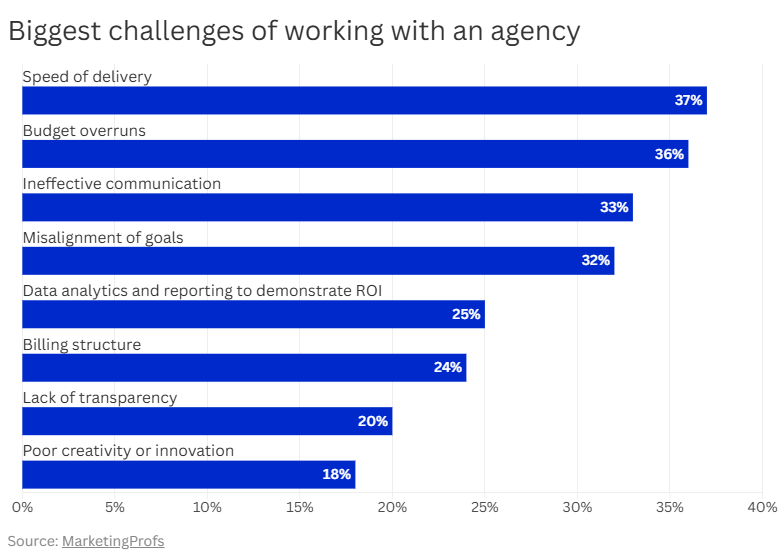
Clients want it done, and they want it done yesterday and for cheaper:
- Speed of delivery annoys clients the most (37%)
- Budged overruns are a bit behind with 36%
- Ineffective communication is at third with 33%
Interestingly, poor creativity is low on the list (18%). So clients like the work agencies do, including yours, but they hate how long it takes and how much extra it costs.
What annoys clients the most? It’s speed of delivery, cited by 37% as the biggest challenge.
The modern client? Impatient and budget-conscious. They will forgive a slightly less “perfect” creative output if it arrives on time and on budget.
Operational efficiency beats perfectionism here.
Fix it now: Review your internal approval processes. If a deliverable sits in “internal review” for 3 days, you are creating your own churn. Cut the red tape.
AI MARKETING: The Deep View gives you the AI context in five minutes a day: what changed, why it matters, and what to watch next. It is built for people who need signal, not another feed to manage. Free, clear, and trusted by 700,000+ readers at Google, Meta, Microsoft, and beyond. Subscribe here. *
REDDIT: Fresh ad formats just landed, including free-form placements inspired by long posts, tailored creative that picks formats by persona, Redditor highlights, and shopping carousels. With half of US shoppers fact-checking AI picks here, these spots could pull weight.
REDDIT: At Cannes 2026, Reddit showed off a bunch of stuff. Tools built on Community Intelligence, turning thread credibility into ad products like Redditor Highlights, and shopping listings, and more. Almost half of shoppers verify AI tips here before buying, so take note.
GOOGLE: Ask Ad Manager drops a Gemini-powered helper right inside Ad Manager, so publishers can fix delivery, pull reports, and move around by chat. Think of it as the publisher cousin to Ask Advisor, fed by your own account data. It hits beta this month.
SHOPIFY: Campaign Autopilot just reached early access, using AI to build, run, and tune campaigns across Meta, Shop Campaigns, and email from one dashboard. You set a budget and guardrails; the robot sweats the rest.
*This is a sponsored post.
I have forests but no trees. I have lakes but no water. I have roads but no cars.
What am I?
You can find the answer here.
Interested in advertising in one of our newsletters?
Connect with over 100,000 of the world’s best marketers who read a newsletter by Stacked Marketer.