
Happy Monday.
We found a site that’s nothing but live webcams from random places around the world. Tokyo crossings, safari waterholes, Earth from the space station.
We opened it “for five minutes” to check a beach in Thailand. That was forty minutes ago.
Anyway, here’s your newsletter.
Snapchat wants to sell you in DMs, California wants everyone out of teens’ feeds

Social media had an interesting week.
While Snap spent time building new places to sell things, lawmakers spent it taking places away.
Straight into the chat: Snap’s Commerce Power Pack puts Dynamic Product Ads inside Sponsored Snaps in Chat, the surface 85% of Snapchatters use regularly. Global, live now.
Three optimization betas came, too. The interesting one is Third-Party Web Optimization. Bid on your GA or Northbeam purchase data instead of Snap’s. Early tests showed 23% lower CPP.
More reasons to open the app: Snapchat Plans lets users invite up to 200 friends to real-world events, RSVPs landing in 1:1 chats.
Partiful should be nervous. More Chat time means more inventory for those catalog ads.
Now about the laws: Newsom signed AB 1709, banning algorithmic recommendations and autoplay outright for under-16s in California. Not parental consent. A ban.
The platforms are swinging back. Google, Meta and TikTok asked the 9th Circuit to freeze the related SB976 law, arguing feeds are protected editorial speech. A district judge already said no.
LinkedIn got away, though: A judge tossed both BrowserGate suits against LinkedIn over scanning Chrome extensions. The plaintiffs couldn’t show that their own extensions leaked anything.
Eventful start of the week, but at least your immediate practical steps are focused on one platform. The regulation part is just a “see what actually happens” kind of news.
Two-word searches are dying, and your keyword list is next
Remember when “cheap flights” was a perfectly good query? Not anymore. Users, including us, are talking to Google like it’s a person.
The tail is now the dog. New Google Ads data shows 1-2-word queries fell from 42% to 24% of impressions since January 2025.
Conversions moved harder. The 3-4-word bucket went from 20% to 46% of conversions. Seven-word queries quadrupled.
So, as marketer Spock would say, “Bid long, and prosper.”
Handy timing, then, that Google Ads is beta-testing budget and bidding experiments: A/B test budgets, tCPA and tROAS across Search campaigns, with AI Max tests that keep brand controls intact.
Less handy: AI Mode is showing more ads. One headphones query returned product results that were entirely paid. Not a single organic listing survived. That’s an ouch, if we’ve ever seen one.
And Google knows the scoreboard is broken. John Mueller conceded Search Console’s AI reporting still thinks in ten blue links.
Impressions count whether or not anyone scrolls. Links behind “Show More” don’t count at all. He’s asking the industry for better ideas.
Two small consolations. Google Analytics launched drag-and-drop Dashboards with six chart types, 15 cards, but no API or segments yet.
And Business Profile post view counts are back after three and a half years, covering Search and Maps.
How to scale first-time depositors by 1,174% without losing customer quality

The moment you start scaling campaign spend, costs go up and the quality of new customers starts to drop. Sound familiar? More budget, higher CAC, slower payback, weaker users – that’s usually where scaling gets painful.
Bitmedia tracked each month’s users against that month’s spend, then scaled only where the numbers kept working.
Here’s what that looked like:
- Track each cohort separately
- Follow payback over D30, D60, D90, and beyond
- Increase budget only when the cohort showed strong returns
- Compare markets to see where customer value was highest
That approach helped increase first-time depositors by 1,174% without losing customer quality.
See the full Bitmedia case study and how the campaign was scaled.
Stacked Marketer readers can also use promo code BITSTACK to get a 10% bonus on their first deposit.
Your crawler finds symptoms. Your audit has to find causes

If you want to get into SEO technicalities, Matt Hollingshead breaks down ten audit mistakes that can make or break your website performance. Let’s check them out.
1) Your crawler isn’t always right. Crawlers report missing titles on pages that render perfectly fine, and log 429s the site only threw because the crawl was hammering it.
Anything handed to a developer should be confirmed in at least two of three places: crawler, Search Console, server logs.
2) JavaScript renders for Google. It doesn’t render for the AI crawlers. Turn on JavaScript rendering, store both the raw and rendered HTML, then diff them.
Copy, internal links and canonicals that only exist after scripts run are shaky in Google’s index and most AI crawlers don’t execute JavaScript at all.
A page can rank on Google and be invisible to the systems writing AI answers.
3) “12,000 duplicate URLs” is an observation, not a finding: The finding is whatever produces them: faceted navigation with no parameter handling, session IDs, a CMS quietly cloning every page.
Delete the 12,000, and they’re back the next time someone adds a filter.
4) Severity columns don’t know which pages make money. Tools rank by issue type, so trivial warnings pile up at the top while a rendering failure on your highest-margin product template sits on page four.
This is where marketers earn their keep: Only you know what’s launching, what converts, and which template is getting deleted in the redesign anyway.
The Crew’s tip: Feed your crawl export and your Search Console indexing export to Claude or ChatGPT.
Ask it to group URLs by template pattern, flag where the two sources disagree, and rewrite each surviving issue as a ticket with affected template, root cause, and acceptance criteria.
Sampling by template and writing dev-ready tickets is the tedious half of the job and the half AI is genuinely good at. Validation still needs your eyes, of course.
Keep in mind that the list of problems is the cheap part. The money is in deciding which ones are real, which ones matter, and what each fix costs.
How 30k+ social media managers and marketers catch the trends before they’re trending

Have you ever noticed how the social media teams at Netflix, Apple, and Disney seem to stay ahead of social media trends?
It’s not because they have a crystal ball of what’s going to trend or not.
It’s because they’re all hooked on the Geekout newsletter. It reveals the latest social media news, expert insights, and hit videos and memes.
So if you want to join 30k+ other marketers and be “in the know” before things go viral…
Fact-finder, pre-shopper, and the other ways AI can help
Traditional search bars are a thing of the past.
Consumers are turning AI into their personal, 24/7 encyclopedia and pre-shopping consultant. Google is playing second fiddle.
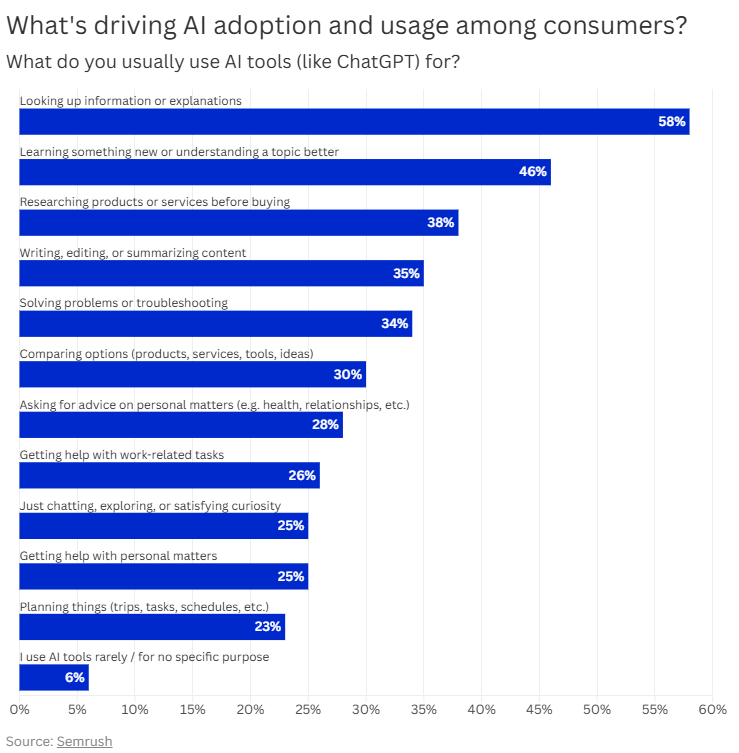
According to Semrush data:
- The primary drivers for consumer AI usage are looking up information (58%) and learning new topics (46%).
- Over a third (38%) use AI to research products or services before buying, while 30% use it to compare options.
- Only 25% use AI for casual chatting, proving consumers view LLMs as practical productivity tools rather than digital toys.
The Crew’s Take: AI has hijacked the discovery phase of the buyer journey.
Consumers rely on chatbots to synthesize product knowledge before visiting your site, making Generative Engine Optimization (GEO) just as vital as traditional SEO.
Actionable tip: Audit how major LLMs summarize your brand.
Publish clear, structured product specs, comparisons, and direct answers on your site so AI assistants surface your business accurately during consumer research.
AI MARKETING: This daily newsletter condenses the latest and greatest AI developments into a 5-minute read. They read the noise, pull out the signal, and explain what actually matters for work, strategy, and the tools your team is already using. Trusted by 700k+ readers. Subscribe right here.*
MICROSOFT: Showing the ad business still matters for the tech giant, it just launched Curate. A platform letting publishers, retail media networks, and data owners package first-party audiences with premium supply and sell it through third-party DSPs. Let’s see how it goes.
AD SPEND: Madison & Wall forecasts global ad revenue hitting $1.3 trillion this year, up 11%, with AI buying platforms handling 27% of US spend by 2030. AI firms are both building the efficiency tools and burning venture cash as advertisers themselves. A loop worth watching.
AI MARKETING: Job postings asking humans to repair or finish AI output grew 70% year over year. They’re calling it “AI remediation.” Before you tally your AI savings, add the research, fact-checking, and editing hours. A draft needing four hours of cleanup isn’t finished yet.
ADVERTISING: A survey of 1,013 Americans found 98% intentionally ignore or avoid digital ads, and 77% do it daily. Another 96% feel overwhelmed by online advertising, while 46% trust print more than digital. How’s your frequency cap looking?
YOUTUBE: Get Feedback is rolling out to US creators over 18 on the Android and iPhone apps. Tap it on the Add Details screen and it reviews your Short’s hook, pacing, and visuals before you publish. It suggests, it doesn’t edit, and it’s entirely optional. But certainly sounds helpful.
*This is a sponsored post.
Interested in advertising in one of our newsletters?
Connect with over 100,000 of the world’s best marketers who read a newsletter by Stacked Marketer.